 RankEngine
You launch a Spanish version of your Shopify store, connect payments, configure shipping, and translate the product catalog. Then you wait for Spanish-speaking shoppers to arrive through Google. Weeks later, the English collection pages still receive the impressions, while the Spanish URLs barely appear in search.
That outcome usually isn't caused by weak products or poor translation alone. Having another language on the storefront is different from making that language discoverable. Search engines need crawlable URLs, clear language and regional signals, localized on-page content, and consistent relationships between equivalent pages. Shopify adds another layer because markets, translation apps, theme code, canonicals, sitemaps, and navigation all need to agree.
Table of Contents
- Why Your New Language Store Disappears Without Multilingual SEO
- How Search Engines Understand Language and Region
- Choosing the Right URL Structure for Your Shopify Store
- Implementing Hreflang Correctly in Shopify
- Translation Quality Tiers and Content Strategy Decisions
- Canonical Tags and Avoiding Self-Cannibalization
- Building a Verified Multilingual SEO Checklist for Shopify
- Next Steps and Measuring Your International SEO Progress
Why Your New Language Store Disappears Without Multilingual SEO
A merchant might have /es/collections/zapatillas available to customers through a language switcher, but Google may still have limited evidence that it should treat that page as a distinct Spanish search result. If the translated page isn't linked consistently, has the wrong canonical, or lacks a reciprocal relationship with its English equivalent, the store has created content without creating a reliable indexation path.

The opportunity is substantial, but the competition differs by language. In an April 24, 2025 snapshot, W3Techs reports that English appeared on approximately 49.2% of websites with an identifiable content language. Spanish represented 6.0%, German 5.8%, Japanese 5.1%, and French 4.5%. The five leading languages together represented roughly 70.6%, leaving about 29.4% across other languages.
Those figures measure website content language, not internet users or search demand. They still illustrate the strategic tension: English offers broad reach but crowded results, while a properly localized Spanish, German, Japanese, or French experience can give a merchant access to a distinct search market. A translated page that Google can't confidently crawl and classify won't capture that opportunity.
Content availability isn't search visibility
Shopify merchants commonly make three production mistakes:
- They translate only product descriptions: Collection titles, blog content, navigation, image alt text, and metadata remain in English.
- They hide languages behind scripts: A visitor can switch language in the browser, but crawlers don't receive stable, indexable URLs.
- They connect every market to the English canonical: Google receives a signal that the localized page is merely a duplicate, even when its search intent and customer experience differ.
The same principle applies to answer-focused search. Clear product attributes, shipping information, and concise category explanations help machines extract information, but ranking and extraction aren't identical outcomes. For a useful companion on fixing extractable answers for SEO, focus on making important facts explicit rather than assuming a translation alone will make them visible.
How Search Engines Understand Language and Region
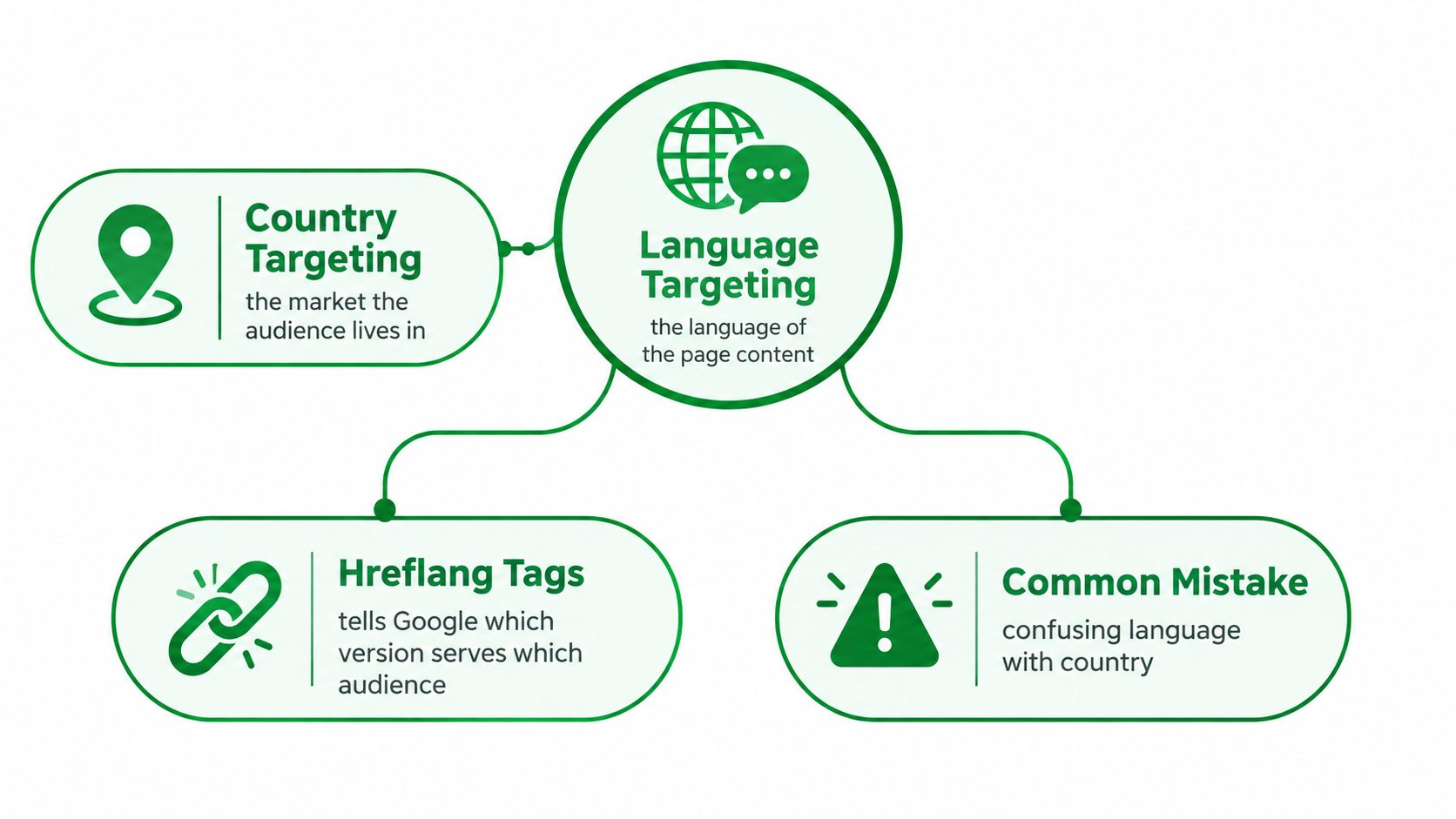
Language and country are separate targeting decisions. A Spanish page tells Google that the content is written for Spanish-speaking users. It doesn't automatically tell Google whether the offer is intended for Spain, Mexico, Argentina, or Spanish speakers elsewhere.
That distinction matters for Shopify because a localized storefront may change more than words. Currency, delivery coverage, returns, product availability, spelling, tax treatment, and legal copy can all vary by market. If those details differ, one generic /es/ experience may not accurately serve every Spanish-speaking customer.
Read hreflang as an audience map
Google's localized versions documentation describes hreflang as a way to connect alternate versions of equivalent content. You can implement those annotations in HTML, HTTP headers, or XML sitemaps. Language values use ISO 639-1 codes, with an optional regional code based on ISO 3166-1 Alpha 2, such as en-US.
A practical interpretation looks like this:
- Language only: Use
eswhen one Spanish URL serves Spanish-speaking users across markets with substantially similar content. - Language and region: Use
es-ESandes-MXwhen the pages differ by pricing, shipping, spelling, product range, or legal requirements. - Fallback: Use
x-defaultfor a neutral selector or default experience when no specific language-region version matches.
Each localized page should identify its alternates and normally include a self-reference. The URLs must be publicly accessible, crawlable, and internally connected. Hreflang doesn't translate a page, guarantee indexation, or replace a canonical tag. It supplies an audience relationship that works alongside those other signals.
For a concise explanation of how regional intent differs from general search optimization, see geo targeting versus SEO.
Choosing the Right URL Structure for Your Shopify Store
Your language architecture should be decided before you translate hundreds of products. Every later task, including internal linking, hreflang, canonicals, redirects, analytics segmentation, and sitemap checks, depends on the URL pattern.
For most Shopify merchants, subdirectories are the most practical starting point. A store might use /en/, /fr/, and /de/ beneath one domain, with equivalent products and collections mapped consistently. Subdomains, such as fr.example.com, can work, but they create a more separated site structure and usually demand stronger governance. Query parameters, such as ?locale=fr, are difficult to manage as primary SEO URLs because they can create ambiguous crawl and canonical behavior.
Compare the main approaches
| Approach | SEO Impact | Setup Complexity | Best For |
|---|---|---|---|
Subdirectories, /fr/ |
Consolidates one domain structure and makes language mapping straightforward | Moderate, especially when apps and themes are involved | Most Shopify stores expanding languages under one brand |
Subdomains, fr.example.com |
Separates experiences and can support independent operations, but requires stronger cross-site management | High | Teams with distinct regional ownership or technical stacks |
Query parameters, ?locale=fr |
Can make crawling, indexing, sharing, and canonical control less predictable | Low initially, high to repair later | Temporary or limited experiences, not a preferred primary SEO architecture |
Shopify Markets can influence regional experiences, but enabling a market isn't the same as designing a complete multilingual URL map. Check what your translation app creates for products, collections, pages, articles, and policies. Then inspect the rendered URLs, not just the settings screen.
Keep equivalent paths equivalent
A visitor switching from an English product to French should land on the corresponding French product, not the French homepage. The same rule applies to collection pages and blog articles. A language selector that always sends users to a homepage breaks context and makes manual QA harder.
Don't casually change a live store from subdomains to subdirectories, or from one market pattern to another. A URL migration can affect canonicals, redirects, internal links, hreflang, and external references at once. If a structural change is unavoidable, use a documented migration plan, and review planning a domain switch for the broader redirect and ownership considerations.
Implementing Hreflang Correctly in Shopify
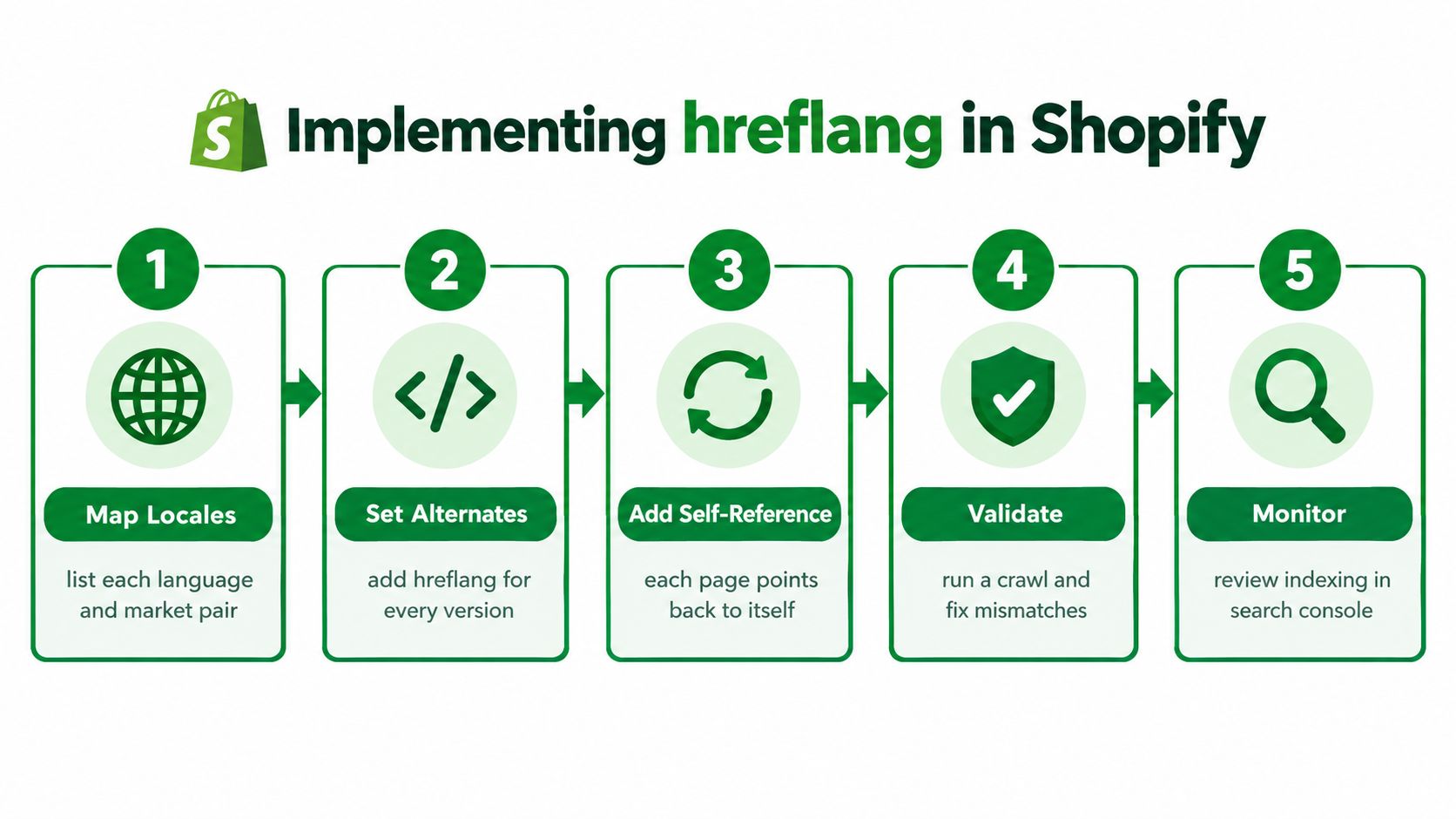
Hreflang failures usually come from incomplete page relationships, not from the syntax itself. A merchant adds tags to the homepage, confirms that the source code contains hreflang, and assumes the whole store is covered. Product pages, collections, blog articles, and newly published content then remain disconnected.
Build the URL map before the tags
Create a row for every indexable page and a column for every language-region variant. Record the live canonical URL, page type, locale, translation status, and whether an equivalent exists. This immediately exposes a common production issue: the English product exists, the German product exists, but the German collection or policy page was never translated.
For an English, French, and German product, each version should identify all applicable alternatives, including itself. The relationship must work in both directions. If the English page points to French but the French page omits English, the implementation is incomplete.
A page that has no genuine equivalent shouldn't receive a fabricated alternate. Link only to valid pages that serve substantially corresponding content. If a market doesn't carry a product, leave that locale out of the relationship rather than sending shoppers to an unavailable page.
Choose the implementation layer carefully
Google supports three implementation methods:
- HTML annotations: Usually the most maintainable option for Shopify because the theme or app can render tags in the document head.
- HTTP headers: Useful for non-HTML resources, but less convenient for ordinary Shopify product and collection pages.
- XML sitemaps: Suitable for centralized management, provided the sitemap relationships and URLs stay synchronized.
Liquid theme integration needs careful handling. The code should output the correct locale code and the complete live URL for the current resource. It shouldn't generate alternates for missing translations, use preview URLs, or combine a localized path with the wrong domain or market.
Check the rendered HTML on the published storefront. Theme editor code, app configuration, and Liquid files are only implementation evidence. They don't prove that the response delivered to Google contains the intended annotations. This Shopify hreflang implementation guide is useful when you need a platform-specific reference while mapping the templates.
Practical rule: A hreflang deployment isn't complete until a crawler and a browser both confirm the live reciprocal relationships.
Validate the live relationship
Run the same checks after launch and after theme, app, or Markets changes:
- Open representative live URLs for products, collections, pages, and articles.
- Inspect the rendered source and confirm the expected language-region annotations.
- Check that every alternate returns a successful response and remains indexable.
- Compare each annotation with the target page's own alternate list.
- Confirm that canonical URLs and hreflang targets don't contradict each other.
- Crawl the store and group errors by missing, invalid, one-way, or conflicting annotations.
A successful tag in one template doesn't prove that a translated blog article or newly added product follows the same rules. Test page types and locales separately.
Translation Quality Tiers and Content Strategy Decisions
Translation quality should follow commercial and search importance. A privacy policy, a high-value collection, and an old support article don't deserve the same workflow, even though all three need linguistic accuracy.

Three workable quality tiers
Machine translation with review can accelerate low-risk catalog coverage. It becomes dangerous when merchants publish it unchanged on hero collections, product benefits, checkout messaging, or legal pages. Awkward phrasing can damage trust and may miss the terms local shoppers commonly use.
Hybrid localization combines machine output with a native-language review and SEO editing. This is often a sensible operating model for broad catalogs, provided the reviewer checks terminology, intent, product attributes, headings, metadata, and calls to action rather than correcting grammar alone.
Native-speaker localization is the right choice for strategic landing pages, important collections, editorial content, and markets where wording carries strong cultural or commercial nuance. The translator should understand the product category and search behavior, not merely convert sentences.
Translate the demand, not just the words
Directly translating an English keyword list can produce unnatural targets. Ask a native speaker how they would search for the product, review local search results, and map the wording to the correct Shopify URL before the copy is finalized.
Prioritize complete journeys:
- Collection pages: Localize the category term, filters, title, description, metadata, and internal links.
- Product pages: Translate benefits, specifications, variants, image alt text, reviews where supported, and structured data fields.
- Blog articles: Adapt examples and terminology so the article answers local intent rather than mirroring English sentence by sentence.
- Policies and support: Provide accurate market-specific information, because a translated promise that the store can't fulfill creates operational and trust problems.
Create a glossary for product names, materials, sizing, shipping language, and brand terms. Your translation workflow should also record which source changes require updates in every language. Otherwise, a new English product claim can leave older translations inaccurate while the storefront continues presenting them as current.
Canonical Tags and Avoiding Self-Cannibalization
Canonical tags and hreflang solve different problems. The canonical identifies the preferred URL for substantially duplicate or variant versions. Hreflang connects equivalent localized pages for different language or regional audiences.
The most damaging setup I've seen on multilingual Shopify stores is a translated French product with a canonical pointing to the English product. The page may contain proper French copy and a French URL, but the canonical tells search engines that the English URL is the preferred representative. That can suppress the localized page from indexing.
Use self-referencing canonicals for localized pages
In a typical language structure:
/en/products/jacketcanonicalizes to/en/products/jacket/fr/products/vestecanonicalizes to/fr/products/veste/de/products/jackecanonicalizes to/de/products/jacke
Each page can then reference the others with hreflang. Don't use the English canonical as a universal destination just because the translations describe the same product.
Shopify themes commonly output canonical tags automatically, but apps, theme customizations, parameter handling, and market logic can alter the result. Inspect the live head on every locale. A settings panel showing translated content doesn't reveal whether the theme is canonicalizing the rendered URL correctly.
Watch for variant and market conflicts
A localized page can be distinct when prices, inventory, delivery, or legal information differ. In that case, forcing all versions into one canonical may erase useful market-specific content. Conversely, creating separate URLs for trivial changes can produce a large set of near-duplicates that need stronger consolidation.
Use a simple diagnostic sequence:
- Is the URL indexable?
- Does its canonical point to itself or to a deliberately preferred equivalent?
- Does the canonical URL match the sitemap entry?
- Do hreflang annotations point to canonical, accessible localized URLs?
- Do internal links reinforce the same locale rather than crossing languages unexpectedly?
For implementation details and common Shopify edge cases, consult this guide to Shopify canonical tags. Fixing a canonical is not enough if the sitemap, internal links, and hreflang map still promote a different URL.
Building a Verified Multilingual SEO Checklist for Shopify
A multilingual audit should test what the customer and crawler receive, not what the merchant intended to configure. I start with a small representative sample, then expand the crawl once the architecture behaves correctly.
Architecture and content checks
- URL coverage: Confirm every active language has stable, crawlable URLs for products, collections, pages, articles, and policies.
- Path matching: Check that a language switcher maps each page to its equivalent resource instead of a generic homepage.
- Language completeness: Look for English navigation, metadata, headings, image alt text, or structured content left inside otherwise translated pages.
- HTML language: Verify that the rendered document declares the correct language for each locale.
- Internal links: Check whether Spanish pages link primarily to relevant Spanish destinations, with intentional exceptions only where no translation exists.
Technical verification
Inspect live responses and record the result for each tested URL:
| Check | Healthy signal | Failure signal |
|---|---|---|
| Canonical | The localized URL is the deliberate canonical | It points to another language without a clear reason |
| Hreflang | Complete, reciprocal, valid alternate set | Missing, one-way, malformed, or conflicting entries |
| Sitemap | Canonical, indexable localized URLs are included | Translated URLs are absent or noncanonical URLs are listed |
| Indexability | Crawlers can access the page and its resources | Robots rules, redirects, or noindex prevent discovery |
| Structured data | Product and relevant page data matches the locale | English text, missing offers, or invalid markup remains |
Use Google Search Console to compare indexing and search performance by URL prefix or locale pattern. Search Console's live inspection can confirm how Google accesses selected pages, while a dedicated crawler can reveal relationships across the full catalog. A browser source check remains essential because it catches app and theme behavior on the actual storefront.
Treat every release as a new audit
Re-run the checks after installing a translation app, changing the theme, activating a market, editing URL behavior, or publishing a batch of products. Keep a record of the URL map and the errors found. That history makes it easier to distinguish a new deployment issue from a page that was never translated.
Next Steps and Measuring Your International SEO Progress
A merchant usually discovers the current state of multilingual SEO by separating performance by locale. Aggregate store reports can make English visibility look healthy while a newly launched German section has no impressions, incomplete indexation, or strong rankings for the wrong landing pages.
Start with a baseline for each language and market combination. Record indexed page coverage, impressions, clicks, click-through rate, ranking queries, organic landing pages, and conversions. These are not vanity comparisons. They show whether the problem is discovery, relevance, snippet quality, user experience, or commercial fit.
Use a repeatable improvement cycle
First, repair structural blockers. Resolve inaccessible URLs, incorrect canonicals, missing reciprocal hreflang, redirect chains, and untranslated navigation before investing heavily in new articles. Content can't compensate for a page that search engines can't reliably classify.
Next, improve localized relevance. Review search queries in each language, rewrite titles and descriptions, expand priority collections, and refine internal links. A page can be technically valid and still target vocabulary nobody uses.
Then, monitor commercial outcomes. Compare qualified organic visits, add-to-cart activity, checkout progression, and sales by locale. If visibility grows but customers can't find suitable shipping or payment options, the SEO program is exposing an operational gap rather than solving it.
For ongoing Shopify diagnostics, RankEngine audits language-specific SEO elements, supports hreflang checks, reviews canonicals and structured data, and verifies supported changes against the live store before marking them complete. Use it alongside Search Console, manual review, and native-language QA rather than treating any single dashboard as proof that the implementation works.
The standard is simple: every localized URL should be discoverable, understandable, internally connected, correctly canonicalized, and validated after deployment.
Review the store on a regular operating cadence, and trigger an extra audit whenever a theme or translation app changes. Build the next language only when the team can support its complete buying journey, maintain its content, and inspect its technical signals in production.
RankEngine audits Shopify products, collections, pages, articles, metadata, canonicals, structured data, sitemaps, internal links, and multilingual SEO signals in one workspace. Visit RankEngine to check your localized URLs, validate hreflang relationships, and monitor verified fixes across the live store.