 RankEngine
Backlink analysis is the systematic study of who links to a site, from where, with what anchor text, and how those links change over time. It's graph analysis, not a vanity count, so 50 links from 50 relevant domains can tell you more than 500 links from one domain.
A Shopify merchant usually asks the question after something changes. Organic traffic wobbles, a collection page stops attracting clicks, or a new competitor appears above a product page. You open a backlink report and find unfamiliar domains, repeated anchor text, old product URLs, and a long list of metrics that don't explain what to do next.
The useful question isn't merely, “How many backlinks do I have?” It's, “Which external relationships support my important pages, which links have lost their value, and which patterns deserve investigation?”
Backlink analysis answers that question by connecting external links with your store's real structure. A link to a live, indexable collection page is different from a link to a discontinued product that redirects elsewhere. A relevant editorial mention is different from a repeated footer link across an unrelated network. The data becomes useful when it leads to a decision.
Table of Contents
- Why Backlink Analysis Feels Urgent for Store Owners
- What Backlink Analysis Actually Means
- The Key Metrics Worth Read in Every Report
- Common Tools and How They Differ
- A Practical Workflow for a Shopify Store
- When to Reach for Disavow, Reclaim, or Outreach
- Turning Backlink Insights Into a Recurring Habit
Why Backlink Analysis Feels Urgent for Store Owners
A traffic decline naturally makes merchants suspect backlinks. That suspicion may be correct, but a backlink report rarely provides a simple verdict. It shows a map of external pages and domains connected to your store, while the cause of a performance change may involve indexing, redirects, content, search intent, or technical accessibility.
Start with the affected URL, not the total link count. If one collection lost visibility, find the external links pointing to that collection, inspect whether the source pages still contain them, and verify that the destination remains live and indexable. A storewide total can hide a commercial problem affecting one important page.
The decision behind the report
A practical audit should help you decide whether to:
- Protect a valuable link: Contact the publisher if a relevant link was removed or changed.
- Repair a destination: Review redirects, canonicals, and discontinued products when links point to an outdated URL.
- Investigate a pattern: Examine sudden spikes, repeated commercial anchors, or irrelevant sitewide placements.
- Find an opportunity: Identify relevant domains linking to comparable stores or content but not to your own.
- Leave a harmless link alone: Not every unfamiliar or low-authority domain requires removal.
This is why a systematic approach beats instinct. A tool's risk label can be a useful sorting aid, but it can't understand your merchandising calendar, product changes, editorial relationships, or referral customers without context.
Practical rule: Treat every backlink as a relationship between a source page and a destination page, not as an isolated vote.
Shopify teams that want a broader introduction to link acquisition can also consult Next Point Digital's backlink guide, particularly when an audit reveals gaps in relevant referring domains. The audit itself should come first, because outreach is more effective when it targets a clear page and a relevant publishing context.
What Backlink Analysis Actually Means
Backlink analysis is the systematic examination of external hyperlinks pointing to a website or page. It evaluates the number of links, unique referring domains, authority and relevance of linking pages, anchor text, placement, follow or nofollow attributes, target URLs, and changes over time.
Think of the web as a network of roads. Your store and every external page are locations, while hyperlinks are roads between them. Counting roads gives you volume, but it doesn't tell you whether they come from useful neighborhoods, lead to the right destination, or all originate from one overbuilt interchange.
Google's original PageRank research provides the intellectual foundation for this view. The 1998 Stanford paper on PageRank described using the web's link structure to calculate a quality ranking for each page and treated links as citation evidence. The model did not count links alone. It assigned greater value to links from important pages and reduced the contribution of a linking page when that page pointed to many destinations.
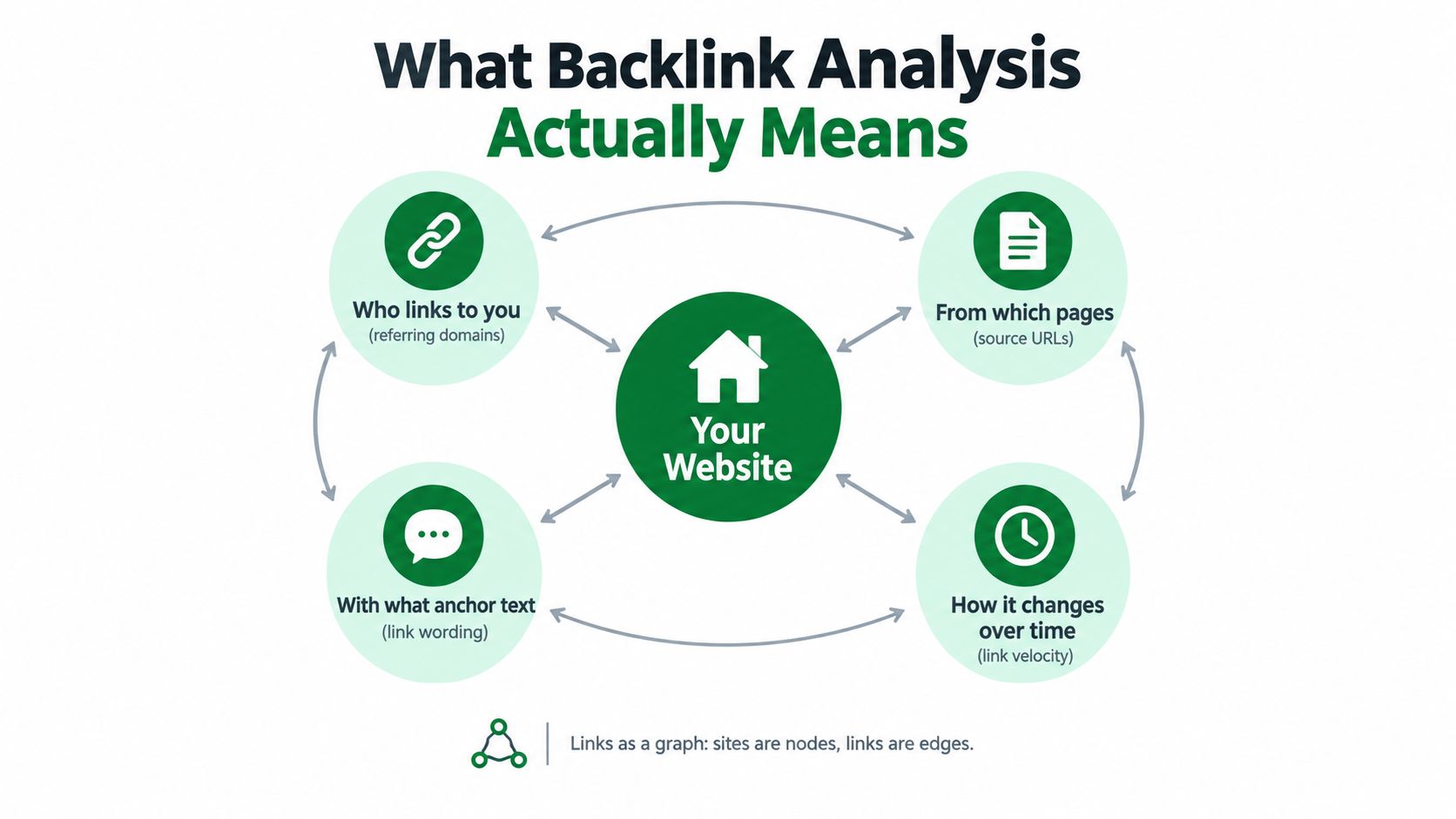
The four questions inside an audit
A useful report answers four connected questions:
- Who links to you? Review unique referring domains, industry relevance, and ownership patterns.
- From which pages? Inspect the exact source URL, its surrounding content, and its ability to be crawled.
- With what wording? Study anchor text for descriptive variety, branded language, and suspicious repetition.
- How does the profile change? Track new, lost, redirected, or altered links over time.
The destination matters as much as the source. Suppose an editorial article links to a Shopify product URL that later redirects to a broad collection. The link still exists, but the user and search engine now reach a different page. If the product remains available under a new URL, a carefully managed redirect or publisher update may preserve more relevance than allowing the old path to drift toward an unrelated destination.
That example also explains why backlink analysis is graph analysis rather than a popularity contest. The analyst studies how authority and relevance move through a network, then checks whether the path ends at a page that serves the original user need.
The Key Metrics Worth Read in Every Report
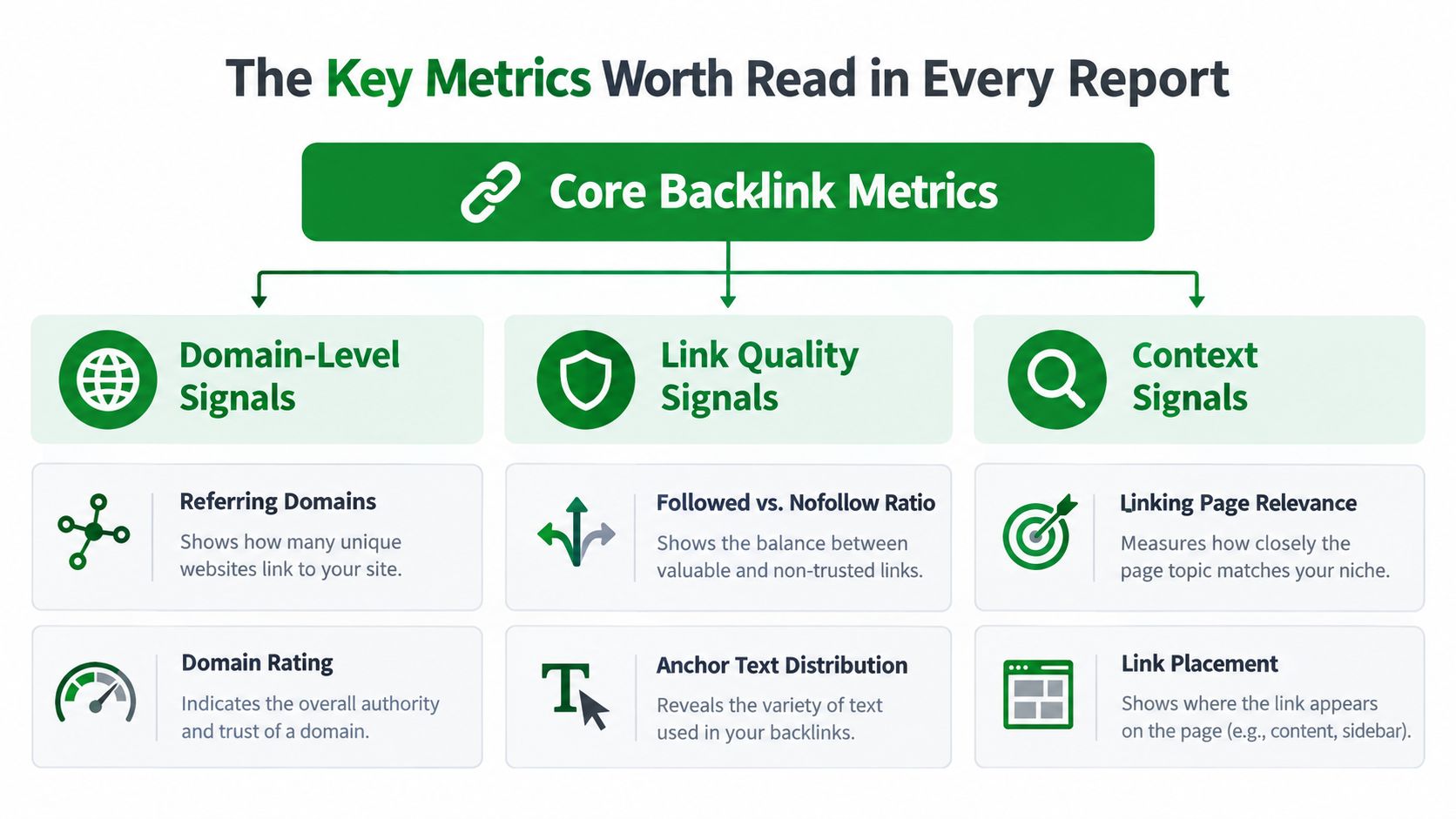
A backlink report becomes easier to interpret when you group metrics by the question they answer. Domain-level signals describe the breadth of the network. Link-level signals describe the individual connection. Pattern-level signals reveal whether the profile looks naturally earned or deliberately engineered.
Domain-level signals show breadth
Referring domains count the distinct websites linking to you. This is often more informative than total backlinks because many links can come from one sitewide template, while links from separate relevant domains indicate broader recognition.
Domain Rating and similar third-party scores can help sort a large prospect list, but they aren't Google rankings and shouldn't become the decision itself. A recent compilation citing an analysis of 1 million Google search results reported correlations of 0.255 for referring domains, 0.248 for total backlinks, 0.242 for followed backlinks, and 0.131 for Domain Rating with ranking position. The source presents these as associations, not proof of causation, in its link-building statistics compilation.
The practical reading is straightforward: a broad, relevant profile deserves more attention than an impressive score attached to a narrow or unrelated network.
Link-level signals explain quality
Review whether links are followed, nofollowed, or marked sponsored, but don't reduce the audit to one attribute. A qualified link can still send referral users and support discovery, while a followed link from an irrelevant or manipulative context may deserve investigation.
Anchor text should describe the relationship naturally. A profile dominated by a store name, product name, and varied descriptive phrases usually tells a different story from one built around repeated exact-match commercial terms. Placement matters too. A contextual editorial mention generally provides more useful information than a repeated sidebar or footer link, especially when the surrounding page discusses the product category.
The linking page must also fit the destination. A gardening publication linking to a relevant tool collection has clearer topical context than an unrelated page linking to the same URL without explanation.
Pattern-level signals expose risk
Investigate sudden link spikes, repeated exact-match anchors, private-network footprints, automated acquisition, and unusual sitewide growth. Google identifies buying or selling links, excessive exchanges, automated link creation, and links required in exchange for goods or services as link spam. Its ranking systems guide recommends qualifying eligible links with rel="sponsored" or rel="nofollow".
Read each metric in context:
- Healthy: Relevant domains, varied anchors, editorial placement, and live destinations.
- Worth watching: Concentration in one domain, older redirects, or links aimed mostly at low-value pages.
- Worth investigating: Repeated commercial anchors, automated patterns, sudden unexplained growth, or paid placements without appropriate qualification.
A multidimensional reading matters because links are only one part of modern search performance. As the same compilation reports, link correlations declined from about 0.29 in an earlier 2019 study to roughly 0.22 to 0.24 in 2024, which reinforces the need to examine content, intent, technical accessibility, and indexing alongside backlink data. For a deeper comparison of third-party authority metrics, see Moz DA versus Ahrefs DR.
Common Tools and How They Differ
No backlink tool shows the complete truth by itself. Google Search Console reports links Google has associated with your property, while third-party crawlers build their own indexes and add useful features for competitor research, historical tracking, filtering, and lost-link discovery.
Backlink Tools at a Glance
| Tool | Best For | Free Access |
|---|---|---|
| Google Search Console | Grounding an audit in Google's own reporting | Yes |
| Ahrefs | Deep backlink research and competitor analysis | Limited access |
| Semrush | Combining backlink, keyword, and competitive workflows | Limited access |
| Moz Link Explorer | Authority-oriented sorting and link discovery | Limited access |
| Browser checkers | Quick spot checks | Usually limited |
Google Search Console should anchor the audit because it exposes top linking sites, linked pages, and anchor text for your property. It doesn't establish that every discovered link is currently crawlable, followed, canonicalized, or sending referral users, so pair it with a crawler and a live-page check. The Search Console Links report is useful evidence, not a complete link-health verdict.
Ahrefs is well suited to historical comparisons, lost-link tracking, competitor profiles, and page-level analysis. Semrush is useful when the same team already works inside a wider SEO and competitive research environment. Moz helps teams that use its authority and spam-oriented sorting as prioritization signals, provided they don't confuse those scores with Google decisions.
Free browser checkers can answer a narrow question quickly, such as whether a page appears to contain a link. They usually won't provide the depth needed for link history, destination grouping, or competitor gap work.
For Shopify operators, the most reliable combination is often simple: use Search Console for Google's view, a third-party crawler for breadth and history, and the storefront itself for destination validation. If you need a practical starting point for discovery, how to find backlinks can help organize the initial collection process.
A Practical Workflow for a Shopify Store
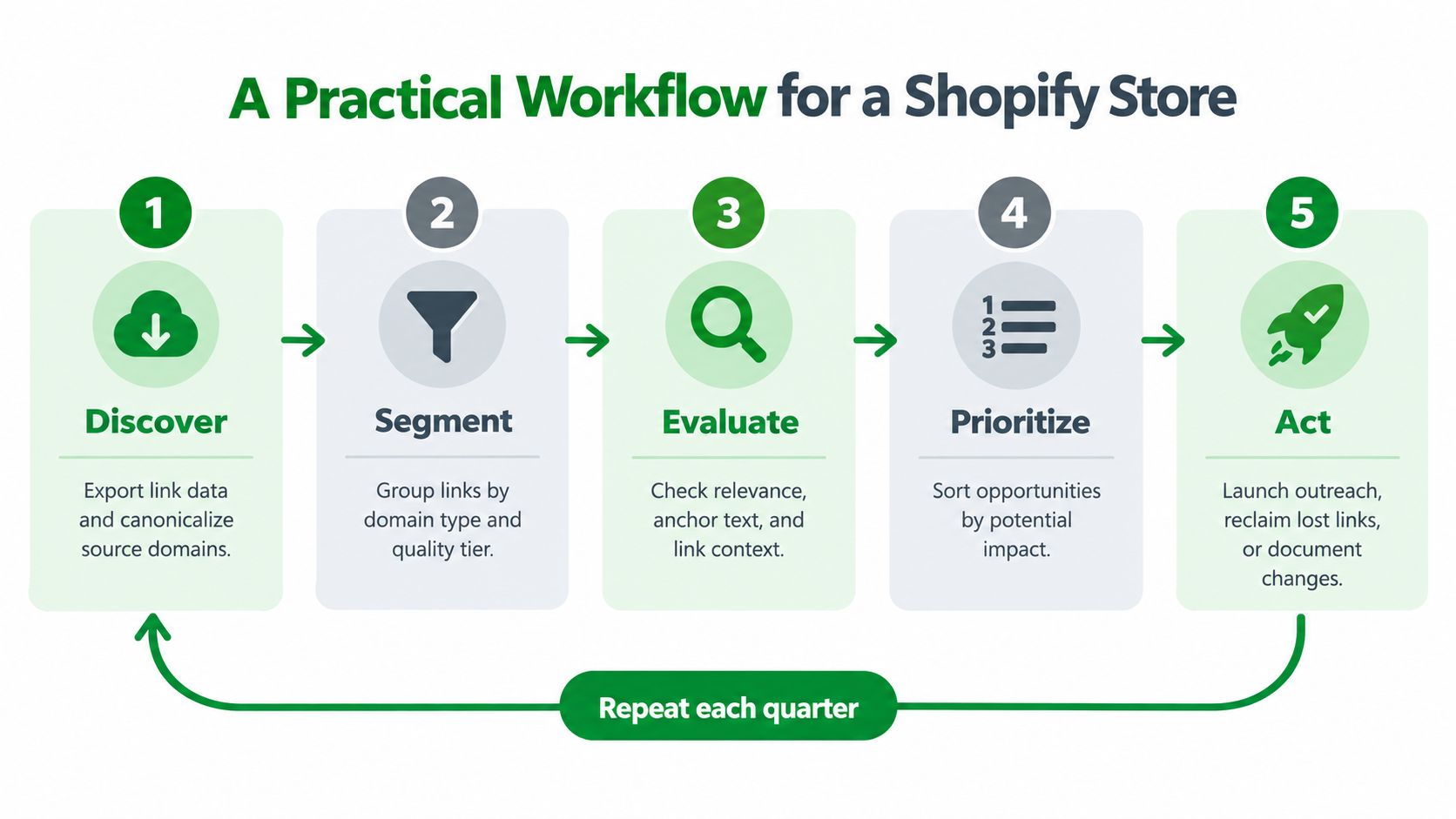
A useful audit ends with an action list, not a screenshot of a dashboard. Run the process in stages so each export answers a specific operational question.
Start with discovery and structure
Discover. Export backlink data from your selected tools, then normalize source URLs and domains. Remove obvious duplication caused by URL parameters, protocol variations, and inconsistent hostname formatting.
Segment. Group links first by referring domain and then by destination URL. The deliverable should show whether links support product pages, collections, blog articles, pages, redirects, or URLs that no longer exist.
Evaluate. Qualify each group by topical relevance, source-page context, anchor text, placement, link attributes, and apparent persistence. Record anomalies in a separate log rather than allowing them to contaminate the main opportunity list.
Map evidence to live Shopify pages
A backlink is commercially useful only when its destination works. Open priority URLs and check whether the page is live, indexable, canonicalized, and aligned with the source article's intent. Use Search Console to compare indexing and performance signals, then inspect Shopify redirects when a product handle, collection path, or blog URL has changed.
This stage catches issues that a raw backlink report misses:
- Product changes: A discontinued item may need a relevant replacement or a carefully chosen redirect.
- Collection revisions: A renamed collection can preserve value only when the new destination matches the old topic.
- Blog maintenance: A linked article that now returns a 404 may need restoration, updating, or a relevant redirect.
- Canonical conflicts: A source may point to a URL that resolves to another canonical page, changing how the link relates to the content.
Turn findings into a queue
Prioritize actions by commercial importance and evidence. Protect strong links to revenue-relevant pages, reclaim lost links where the original context remains valuable, repair broken redirects, and investigate suspicious patterns separately.
The final deliverable should include a destination-URL list, a referring-domain opportunity list, an anomaly log, and an action owner for each item. Repeat the workflow periodically so link resilience becomes part of store maintenance rather than an emergency response.
When to Reach for Disavow, Reclaim, or Outreach
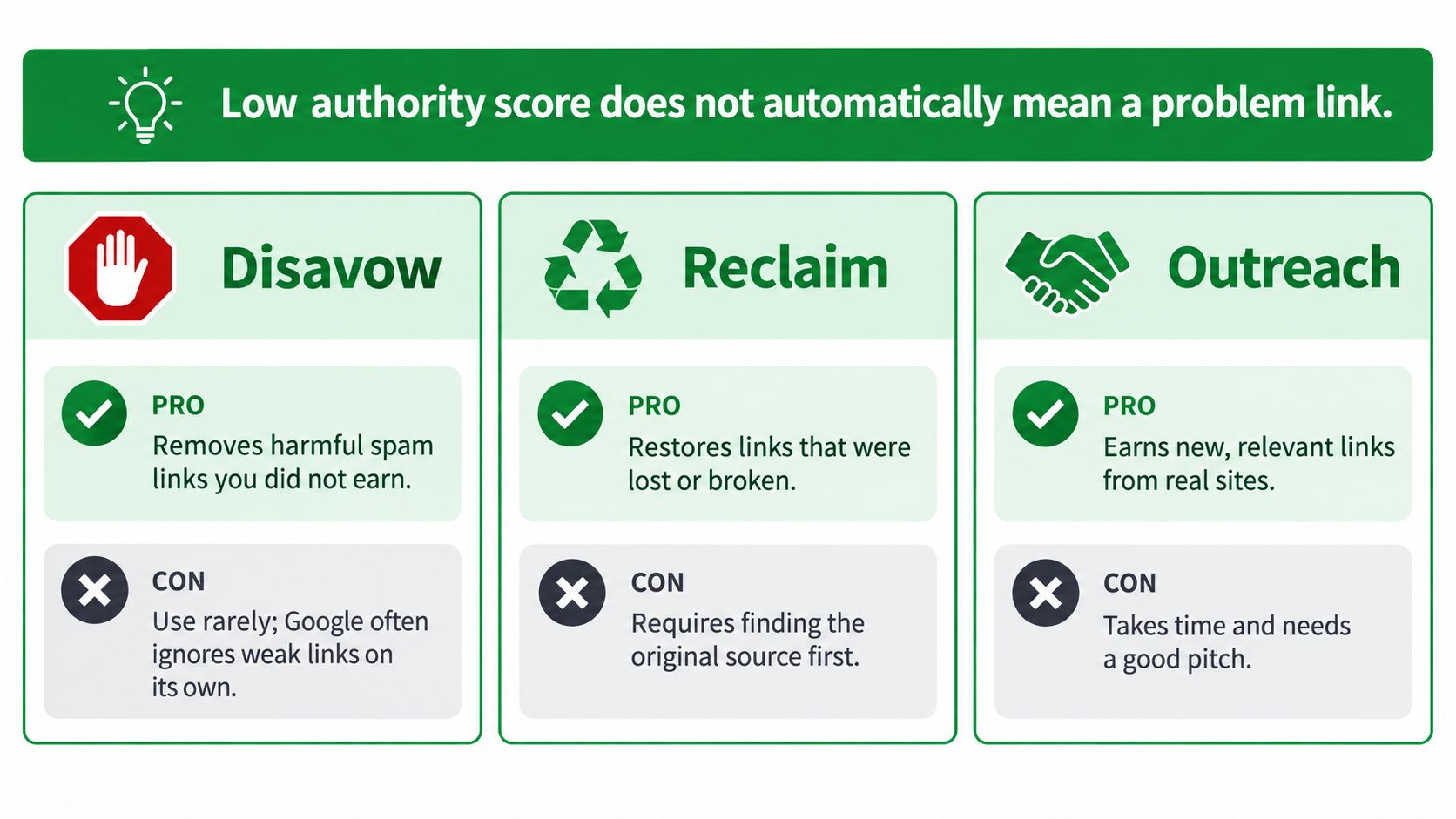
A low authority score doesn't automatically make a backlink harmful. Backlink analysis isn't backlink removal, and Google says spammy links may just have their ranking effects neutralized. Removing or disavowing them doesn't automatically restore lost visibility, so the action should follow evidence rather than a tool's toxicity label.
Four different situations need four responses
Harmless automated links often appear through scraping, templates, or unrelated mentions. If there's no sign that your team created them to manipulate rankings, record them and monitor the broader pattern. A merchant shouldn't spend valuable time removing every unfamiliar link.
Deliberately manipulative links deserve a closer review when the pattern shows paid placements, excessive exchanges, automated creation, or a network designed to influence rankings. Google's spam update guidance explains why systems may neutralize the benefit of spammy links. If you control the placement, remove or qualify it. If you don't, document the evidence before considering a disavow submission.
Hacked or injected links are a different problem. They may appear on compromised pages or in unexpected sections of a site and can require communication with the site owner, security remediation, and monitoring. Don't classify a hacked link solely by domain score.
Links associated with a manual action require direct attention to the notice, affected patterns, and reconsideration requirements. Search Console's Links report can surface items to investigate, but it doesn't prove that a penalty exists.
Choose the action that matches the evidence
Use reclaim when a valuable link points to a broken or changed Shopify URL. A publisher update can be preferable to losing context through an unsuitable redirect. The link reclamation guide provides a focused framework for finding the original source and recovering that relationship.
Use outreach when the source is relevant and the page offers a credible reason to mention your store, product, research, or editorial resource. Directory placement can be appropriate when it reflects a real community or niche. For example, a team evaluating directory submissions for SaaS founders should still assess relevance, editorial standards, and intent instead of treating every directory as equally valuable.
Use disavow cautiously when you have strong evidence of manipulative links that you can't remove and a reason to believe they require formal handling. The objective is resilience, not a perfectly clean graph. Preserve and reclaim the connections that still support live, indexable, revenue-relevant pages.
Turning Backlink Insights Into a Recurring Habit
Backlink analysis becomes more valuable when it feeds the rest of the Shopify SEO workflow. A lost link to a product page may require a redirect repair. A collection with strong external references may deserve refreshed copy and clearer internal links. A well-linked article can inform new content briefs, product education, and answer-oriented pages.
Keep a recurring record that connects four items:
- External change: New, lost, altered, or redirected link.
- Store state: Live URL, canonical target, indexation status, and page intent.
- Search response: Clicks, impressions, and non-branded ranking movement in Search Console.
- Business action: Outreach, reclamation, content refresh, redirect repair, or monitoring.
This turns backlink analysis into a decision system rather than a monthly vanity report. It also helps teams prepare content and product information for search experiences that rely on clear, machine-readable answers, not just traditional result pages.
At the next audit, begin with priority URLs, group links by source and destination, qualify context, validate live pages, and assign actions. That sequence gives a Shopify team a clear way to protect link value while improving the pages those links are meant to support.
RankEngine audits and monitors Shopify SEO signals, including backlink profiles and potentially harmful links, while connecting findings with redirects, indexing, canonicals, content, and live store data. Visit RankEngine to turn backlink findings into a repeatable workflow with monitoring and verified Shopify-focused fixes.