 RankEngine
Buying the AI SEO tool with the longest feature list isn't a strategy. The wrong platform can produce impressive dashboards and polished drafts without improving the pages customers, crawlers, or AI systems read. The best AI SEO tool depends on the job, and whether your team needs research, recommendations, implementation, or proof that an edit reached the live store.
Start with the bottleneck. Missing product metadata calls for a different workflow than competitor research, buying-guide production, technical remediation, or monitoring brand mentions in AI answers. In a Fractl and Search Engine Land study, 70% of consumers said they used AI tools for search more frequently than the previous year, supporting the case for looking beyond conventional rankings without abandoning them (AI-search adoption research).
A generated recommendation isn't an implemented fix. An implemented fix isn't evidence of better rankings, citations, or sales.
For Shopify merchants, those distinctions should guide purchasing decisions. Compare implementation control, automation limits, Shopify compatibility, and pricing complexity, not just whether a product has an AI button. For another perspective on the generative-search side, see how Wispra fits GEO.
The tools below serve different parts of that workflow. Some help decide what to change. Others can change store data. The important question is what your team must still do after the software finishes.
Table of Contents
- 1. RankEngine
- 2. Semrush
- 3. Ahrefs
- 4. Surfer
- 5. Frase
- 6. seoClarity
- 7. StoreSEO
- 8. Avada AI SEO Image Optimizer
- 9. SearchPie
- 10. TinySEO
- Top 10 AI SEO Tools: Feature Comparison
- Build the Stack Around the Bottleneck
1. RankEngine
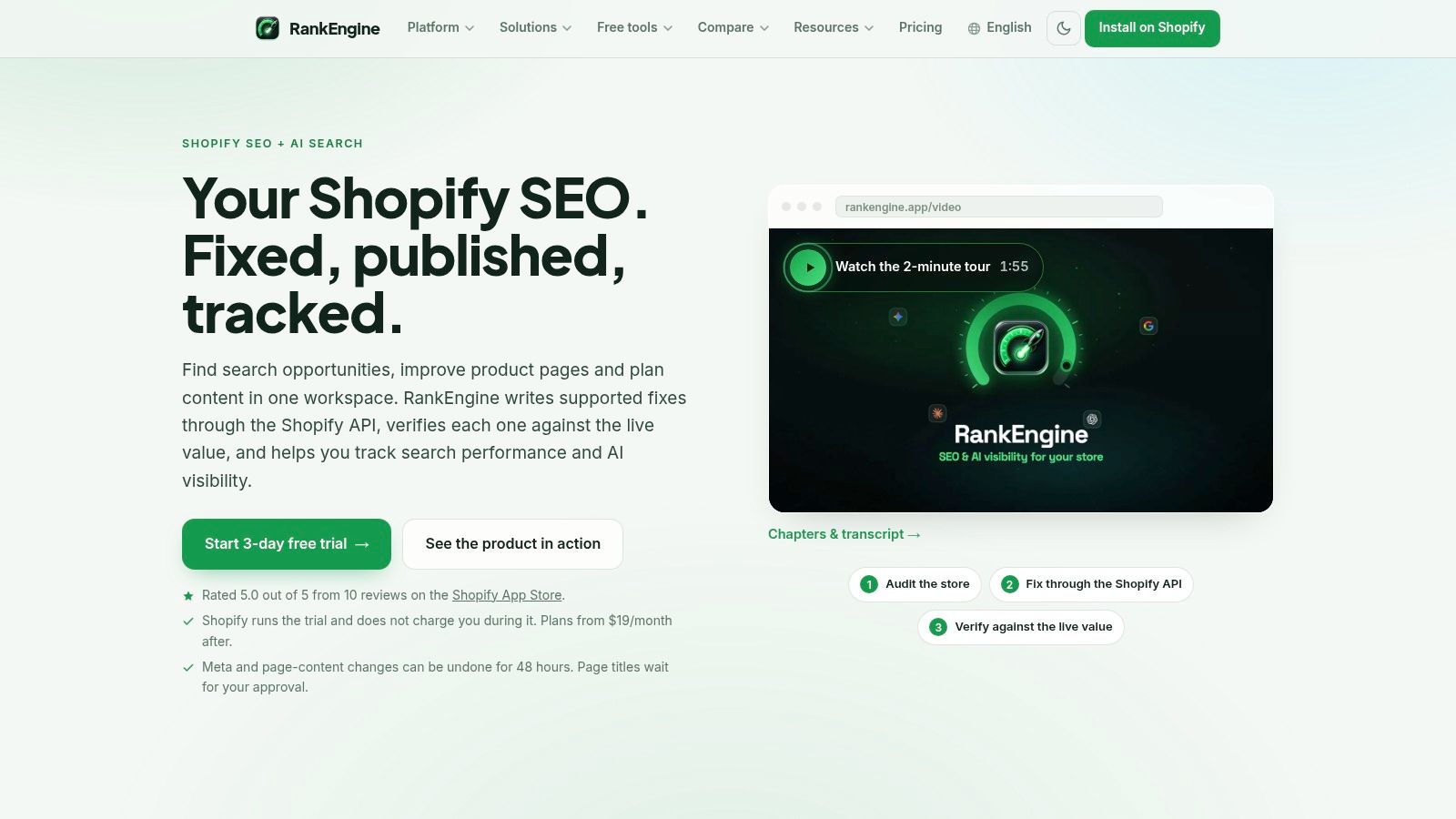
Best for Shopify implementation with verification of supported changes. RankEngine is the most focused starting point in this roundup when the problem is unresolved store SEO work rather than a shortage of recommendations. Its Shopify AI SEO tools combine auditing, content assistance, technical controls, structured data, research, and AI-visibility monitoring.
RankEngine scans Shopify products, collections, pages, articles, and images using store data alongside live-store checks. Supported edits, including meta descriptions, alt text, schema, redirects, and selected technical settings, are written through Shopify and read back for verification. That distinction matters when a merchant needs to establish whether a proposed fix persisted.
Where implementation control matters
Consider a catalog with incomplete descriptions and inconsistent image alt text. The useful workflow isn't generating replacements, it's reviewing them, applying supported edits, checking the resulting values, and retaining a record of what changed. RankEngine provides change history and an undo option for eligible edits, while page-title changes require approval.
- Merchant control: Optional Autopilot rules handle routine work, while tasks requiring judgment remain separate.
- Connected monitoring: Keyword and competitor tracking sit alongside Search Console, Bing, multilingual SEO, and AI-search monitoring.
- Separate evidence: Readiness checks and observed mentions across ChatGPT, Claude, Gemini, and Perplexity are reported separately.
The limitation is scope, not just automation. Merchants may still need to approve titles, connect reporting accounts, adjust theme settings, or arrange deployment of root-level discovery files. A readiness score doesn't guarantee citations, and verified edits don't guarantee traffic or sales.
Compare plan allowances against the catalog and workflows you intend to manage. Prioritize the supported changes you can verify over the volume of AI copy you can generate, and test the approval and rollback process before enabling broader automation.
2. Semrush
Best for broad keyword research, competitor analysis, and coordinated reporting. Semrush fits teams whose main question is where to compete, rather than how to push approved edits into Shopify. Its toolkit combines keyword research, position tracking, site audits, competitor analysis, and plan-dependent AI-visibility features.
For a merchant expanding a product category, a practical workflow is to investigate search demand, compare competing category pages, identify useful supporting content, and assign the resulting work. AI visibility reporting can add another perspective on whether the brand appears in selected answers. It shouldn't replace checking which pages attract qualified visitors.
Buy for the research you'll use
Semrush's breadth is useful when an SEO specialist, content lead, and marketing manager need related research and reports. It can also be excessive for an owner who mainly needs missing metadata corrected. Before subscribing, distinguish core research access from content features, custom-prompt tracking, and other capabilities that depend on the plan.
- Strong fit: Teams coordinating conventional SEO research with AI-search reporting.
- Main trade-off: A broad subscription can include functionality a small merchant rarely uses.
- Implementation gap: Research and audit recommendations don't verify changes to Shopify storefront data.
Use the ecommerce SEO tools comparison to distinguish research platforms from store-side optimization apps. If an audit identifies an issue, assign an owner and a verification step outside the research report. Otherwise, the team can improve its reporting process while leaving the original storefront problem unresolved.
3. Ahrefs
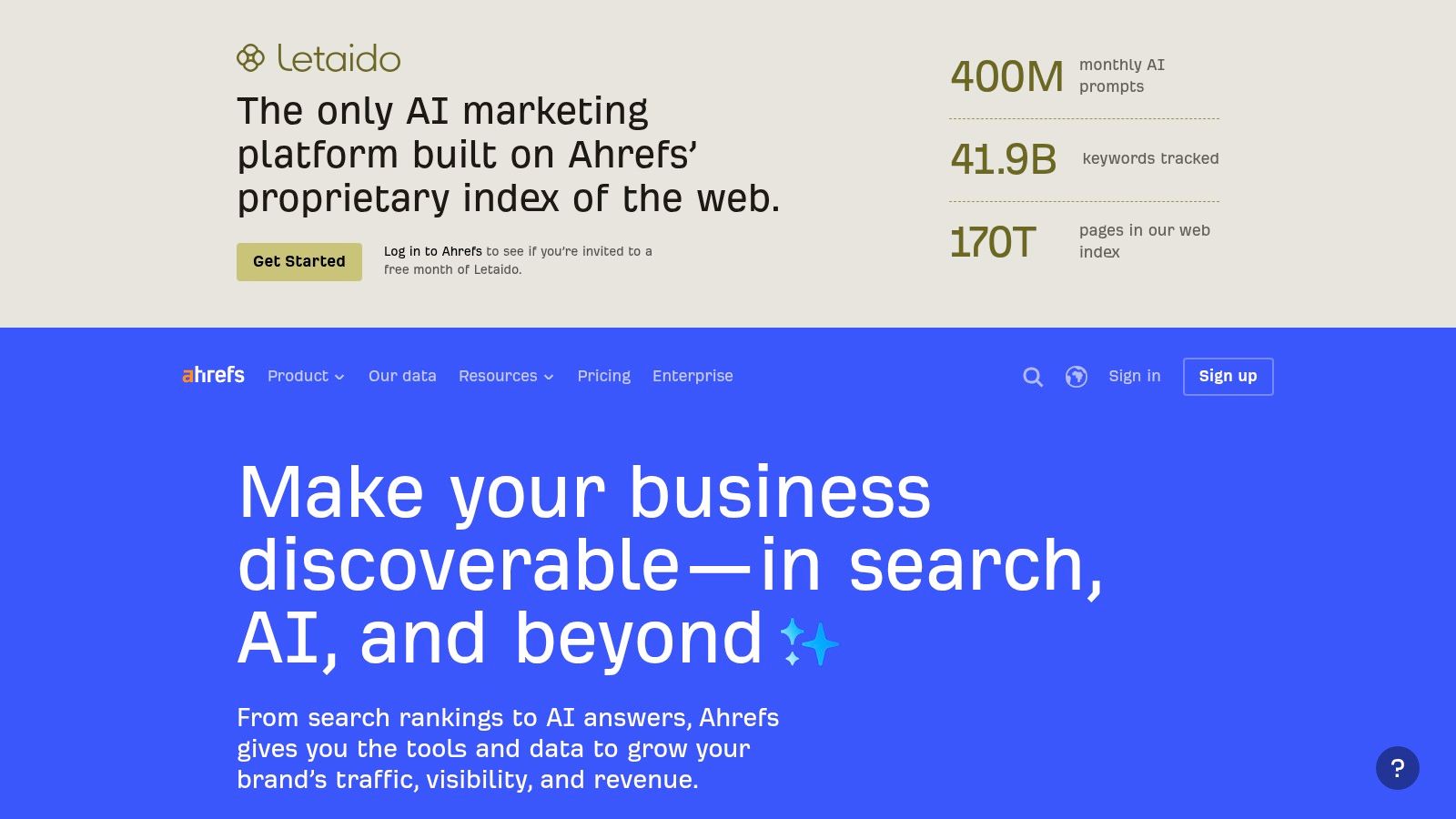
A competitor keeps appearing for valuable category searches, but you don't know whether the advantage comes from content, links, or page structure. That's a research problem well suited to Ahrefs. Site Explorer, Keywords Explorer, Site Audit, and Rank Tracker support that investigation, with Brand Radar and content assistance extending the workflow into AI-related analysis.
The practical advantage is context. Before commissioning another buying guide, inspect competing pages, their topic coverage, and their backlink profiles. Then decide whether the missing work is editorial, technical, or related to earning relevant third-party references.
Keep research separate from execution
Ahrefs can surface opportunities and technical issues, but it doesn't directly apply and verify Shopify Admin API changes. A specialist still needs to translate findings into approved tasks, make the edits through an appropriate workflow, and inspect the result.
Cost and access deserve attention. Content assistance, brand monitoring, tracked prompts, and usage allowances depend on the package. Free webmaster tools offer an entry point for some site data, but they shouldn't be treated as equivalent to the full research workflow.
For teams considering assistant-connected research, compare alternatives to Ahrefs MCP against the specific information and actions required. Connectivity alone doesn't establish that an assistant has sufficient evidence to recommend an edit.
Ahrefs is a strong choice when backlink and competitor research will influence decisions. It's less compelling as the only purchase for a merchant whose immediate backlog consists of routine Shopify edits.
4. Surfer
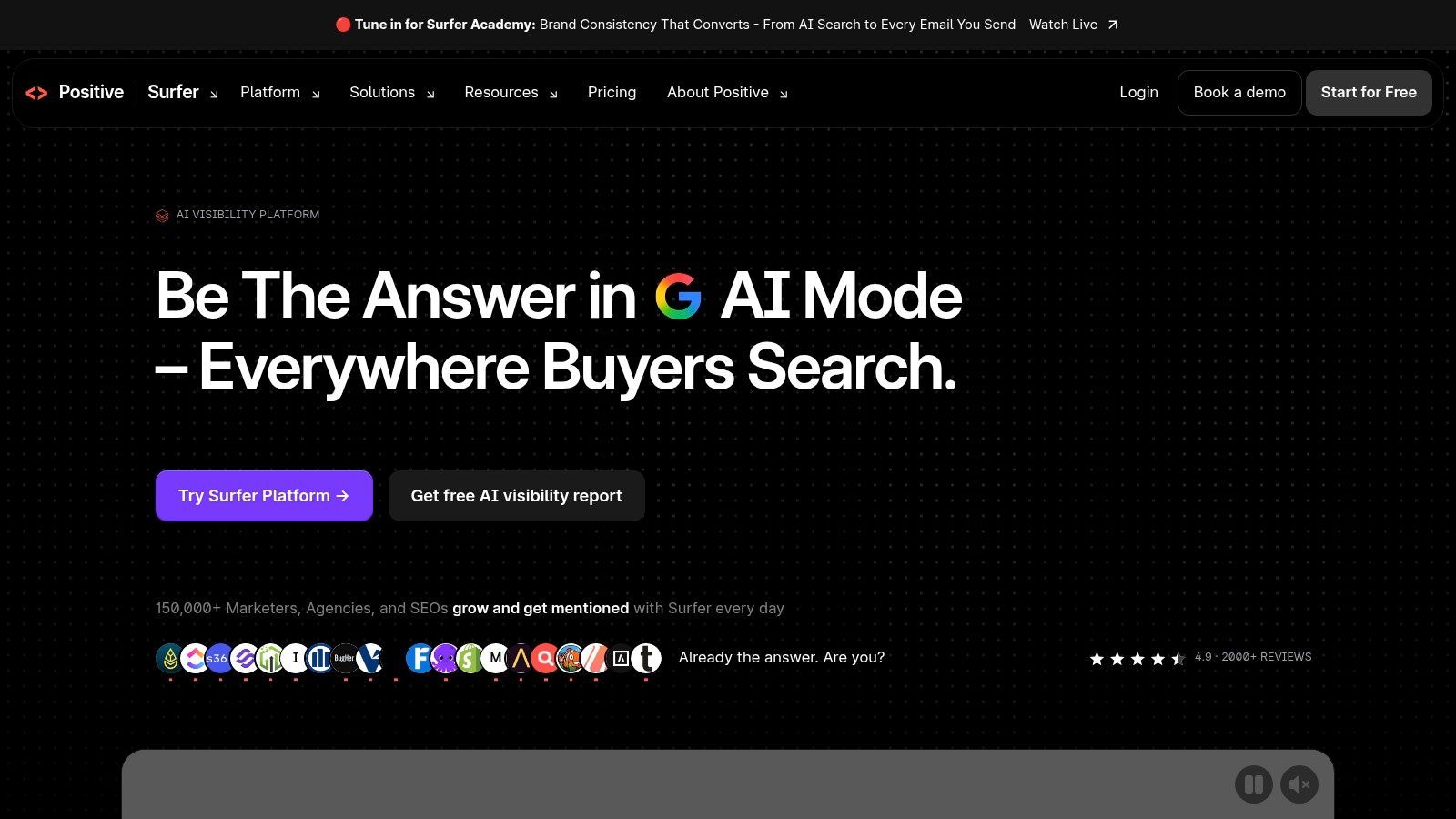
Surfer belongs at the editorial desk, not at the center of catalog remediation. Surfer combines content optimization and auditing with AI Search Analytics for monitoring brand presence in selected AI-generated answers. It's relevant when writers need help improving buying guides, comparisons, and product-education content.
Suppose a merchant publishes a guide to choosing a travel backpack. Surfer can help the editor compare topical coverage against search results and identify questions the draft hasn't addressed. The editor still needs to verify capacity, materials, warranty terms, and other product details against authoritative information.
Editorial rule: Use optimization suggestions to identify missing explanations, not to justify inserting every suggested phrase.
A content score is useful as an editing aid. It isn't proof that a guide is accurate, distinctive, persuasive, or likely to receive an AI citation. Adding generic paragraphs to raise a score can make a useful buying guide harder to read.
Check the reporting package separately
Surfer's AI-search capabilities include prompt tracking, brand visibility measures, and shareable reporting, with access depending on the plan. Workspaces can support separate brands or clients, while documented AI Search Analytics capabilities include MCP access.
The trade-off is purchasing complexity. Confirm whether the content workflow and AI tracking you want sit in the same subscription, and whether the tracked prompts reflect real buying questions.
Surfer doesn't provide Shopify catalog management or a verified-fix workflow. Choose it when editorial improvement is the bottleneck, then retain a separate process for publishing, validating product facts, and checking the live page.
5. Frase
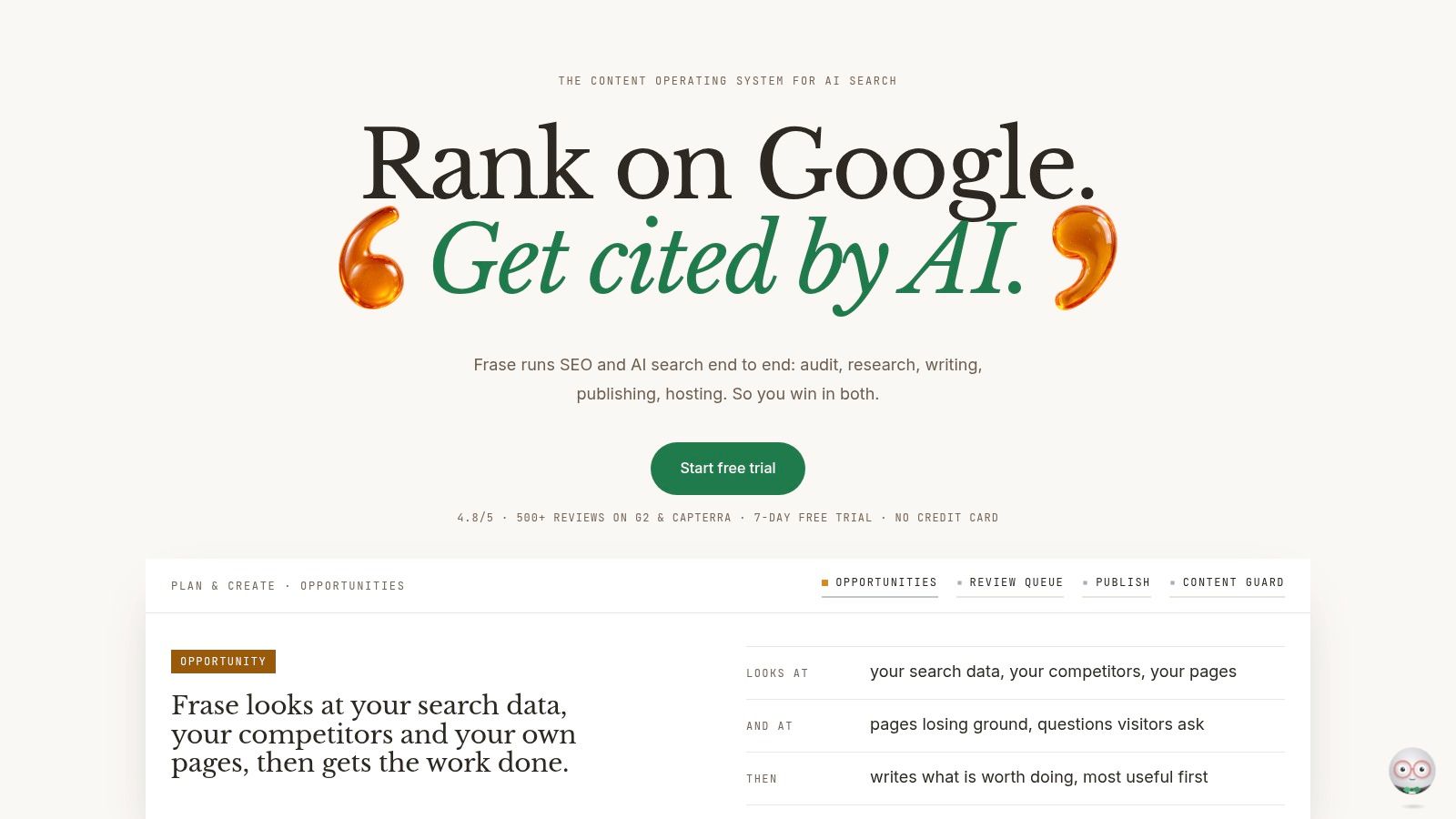
Best for keeping research, drafting, optimization, and content maintenance together. Frase supports topic research, brand-voice drafting, traditional SEO and AI-readiness scoring, and monitoring of published pages. That makes it relevant to merchants producing educational articles rather than filling catalog fields.
A useful scenario is maintaining a product-care library. An editor can research customer questions, prepare a draft, check its coverage, approve publication, and revisit it when the information needs updating. Frase also offers Frase Answers, a conversational site widget that uses site content.
Confirm the publishing handoff
Shopify teams should inspect the integration boundary before committing. The reviewed publishing integrations include WordPress, Webflow, Sanity, and Wix, but didn't list Shopify publishing support. Don't assume an integrated content workflow will publish directly into your store.
- Where it fits: Buying guides, product education, blog production, and content updates.
- Where it falls short: Technical Shopify remediation and catalog-wide verified changes.
- What to verify: Seats, site allowances, AI-engine coverage, and the actual approval-to-publication process.
Human approval remains part of the default publishing process, which suits teams that need editorial accountability. Keep a clear source of truth for product claims and prevent draft updates from changing specifications or policies without notice.
Compared with Surfer, Frase deserves particular attention when managing the content lifecycle is as important as optimizing an individual draft. Neither tool's readiness score should be presented internally as evidence of rankings or AI citations.
6. seoClarity
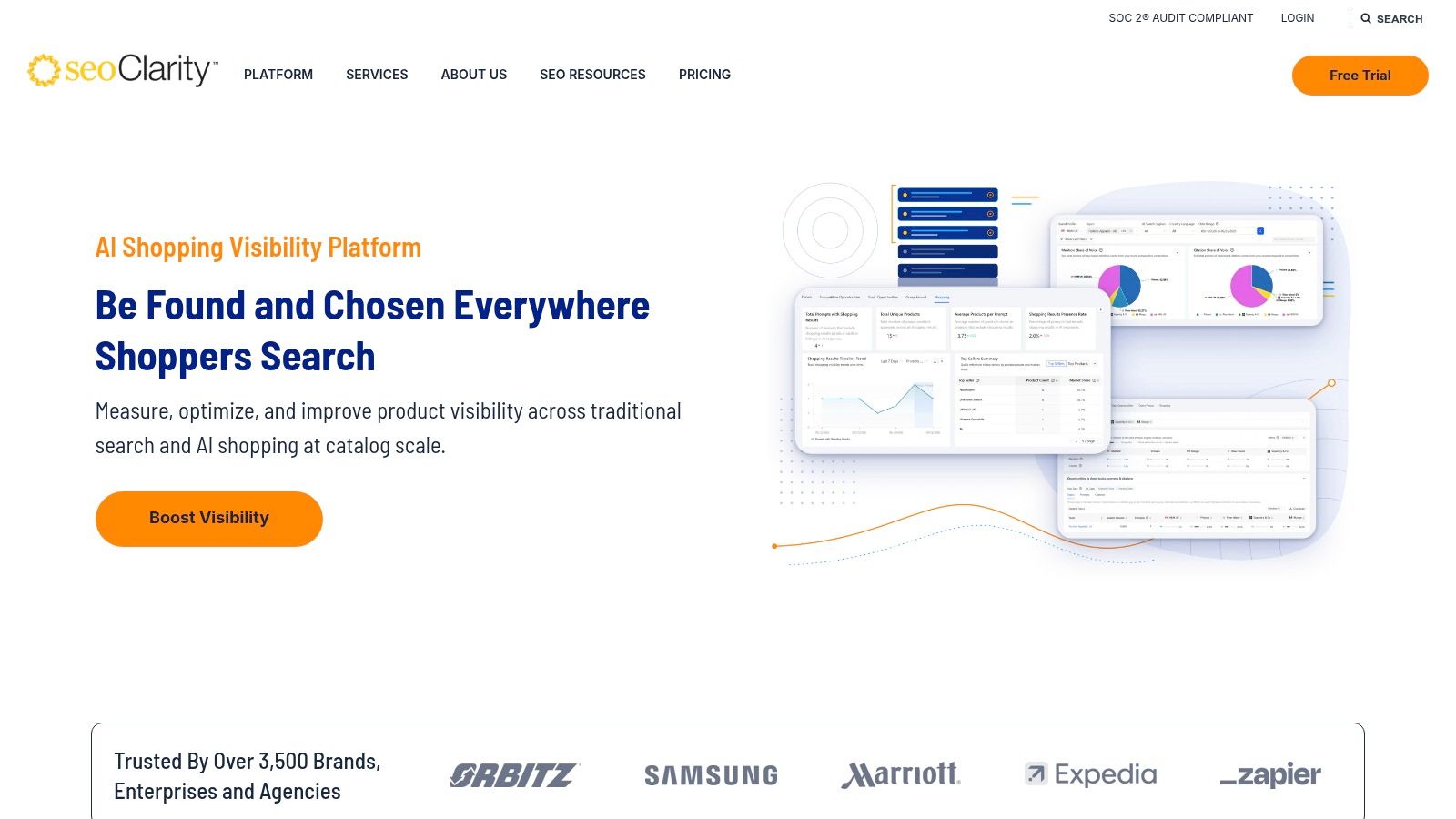
For a larger brand, the bottleneck may be coordinating research, technical monitoring, content teams, and reporting across a complex operation. seoClarity addresses that enterprise workflow through its broader SEO platform and ArcAI capabilities. It's a specialist-owned platform, not an obvious low-cost replacement for a Shopify app.
Its scope includes rankings, audits, content analysis, competitor research, AI citations and mentions, prompt research, sentiment, bot activity, and AI-shopping visibility. Automation products also support implementing certain SEO changes and tests. Product-feed and shopping-related capabilities make it relevant to ecommerce teams evaluating more than editorial visibility.
Require an implementation demonstration
Enterprise automation needs a precise explanation of where edits happen. Ask the vendor to demonstrate the proposed Shopify workflow, identify integration requirements, and explain how your team will inspect, approve, and reverse supported changes.
- Operational strength: Conventional SEO and AI-search analysis can sit within a broader enterprise process.
- Integration options: API and MCP access can support connected workflows, subject to the proposed setup.
- Practical constraint: Customized pricing and broad functionality require clear ownership and a defined business need.
Don't assume that a platform's ability to implement certain changes equals native support for every Shopify object or theme configuration. Have the technical team review the actual deployment path.
seoClarity makes sense when organizational coordination and enterprise analysis justify the setup. For a small merchant primarily correcting product descriptions or image alt text, its breadth may create more administration than the immediate problem requires.
7. StoreSEO
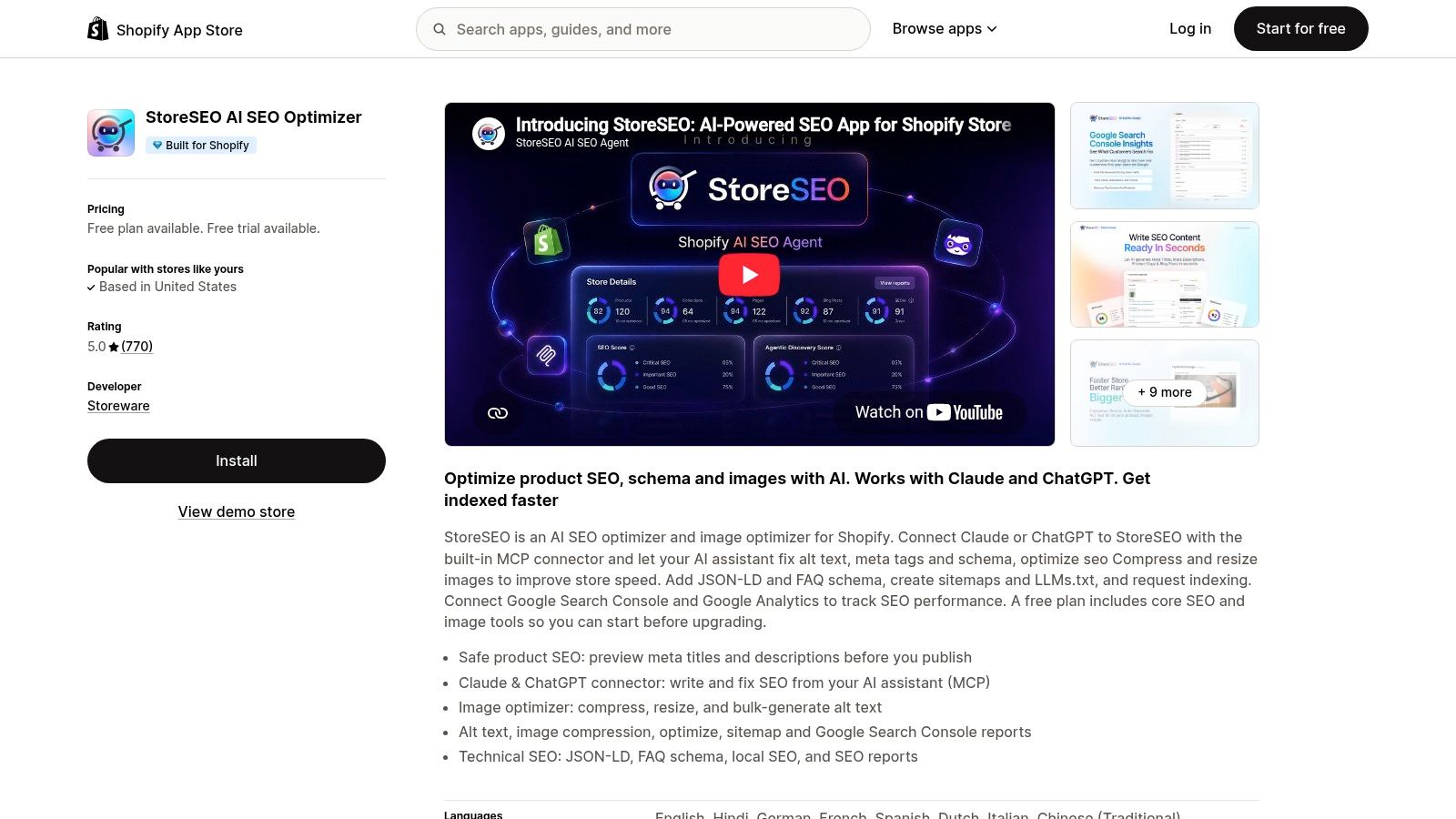
StoreSEO is worth considering when routine Shopify optimization and assistant connectivity are the main requirements. The StoreSEO Shopify listing describes product metadata, image optimization, schema, indexing features, and MCP connections for Claude and ChatGPT.
For an operator working through incomplete product information, that combination is directly relevant. Metadata and alt text can be addressed alongside compression, resizing, structured data, and reporting connections. The assistant connection adds another interface for certain tasks, but merchants still need to understand what actions it can perform.
Treat assistant access as operational access
Before connecting an assistant, establish whether the intended workflow reads information, proposes edits, or writes changes. Review the permission scope and test a representative set of products before approving broader actions. A fluent response from an assistant isn't sufficient evidence that the requested store change happened correctly.
StoreSEO offers a free plan, while higher-volume AI credits and multilingual capabilities depend on the tier. Compare the package against the catalog work you need to complete, including ongoing maintenance rather than just initial cleanup.
The main trade-off is verification responsibility. Check completed tasks against Shopify values and the rendered storefront instead of relying only on the app's status message. For schema work, inspect the resulting output and whether it agrees with visible product information.
StoreSEO fits merchants who want Shopify-focused SEO functions with MCP-based assistance. It isn't a substitute for competitor research, editorial strategy, or a separate measurement plan for citations and commercial outcomes.
8. Avada AI SEO Image Optimizer
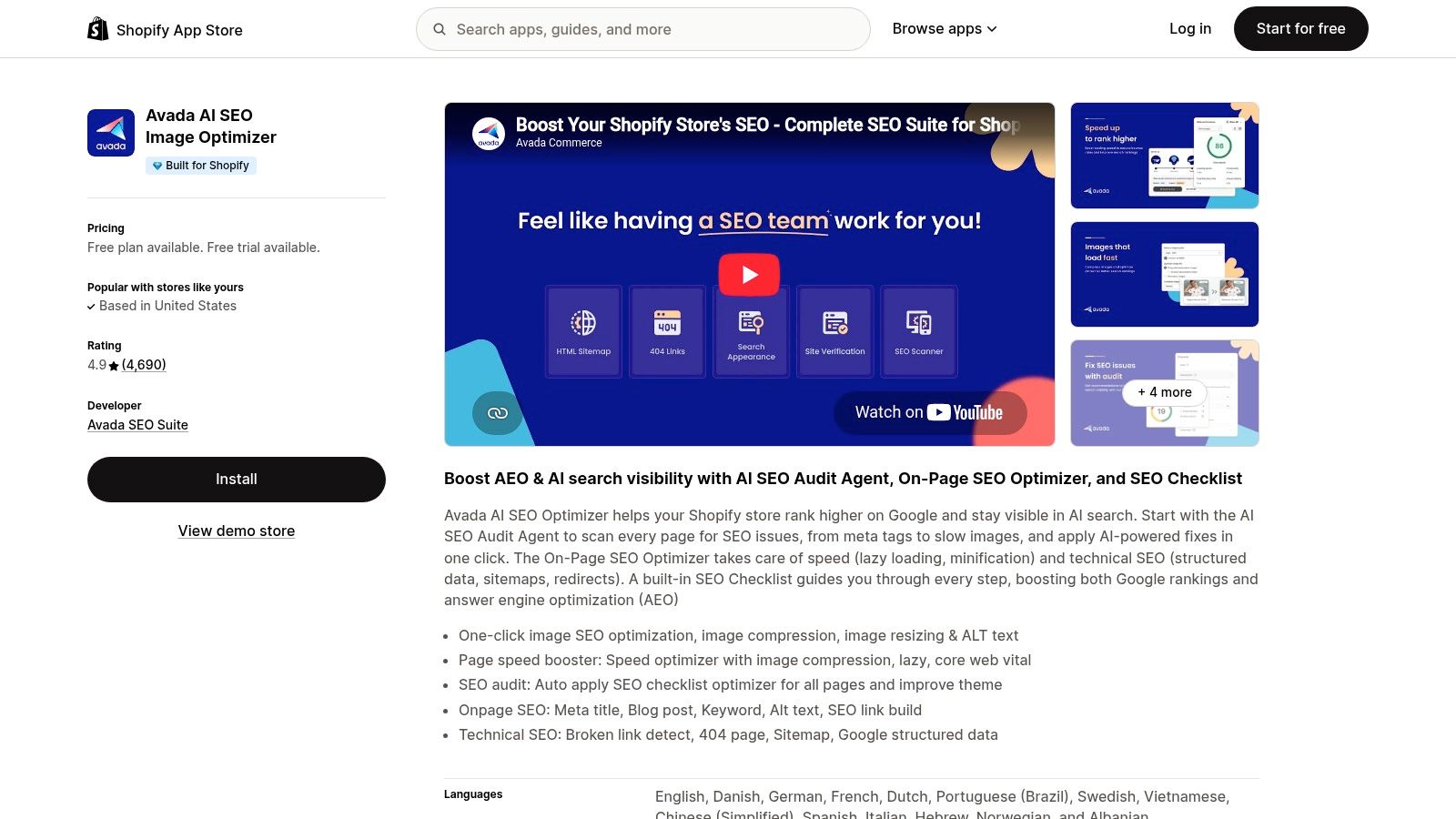
A merchant with oversized imagery, incomplete alt text, and unresolved on-page issues needs practical store maintenance before another AI-content subscription. Avada AI SEO Image Optimizer combines those maintenance jobs through image optimization, audits, metadata, structured data, and speed-related tools.
Its appeal is consolidation. A team can review routine image and SEO work within a Shopify-focused app rather than buying a separate tool for each task. AI content assistance and higher-tier audit capabilities extend that toolkit, but they shouldn't distract from testing the underlying changes.
- Image work: Review compression, resizing, and alt text against the needs of your product photography.
- Technical work: Inspect schema, redirects, broken-link handling, and robots settings before broad deployment.
- Plan selection: Check which functions and AI-credit allowances require a paid tier.
Review changes in the theme
For a visually led store, inspect optimized images on product and collection templates. Test relevant storefront interactions after enabling speed-related settings, and document what the app changed. That gives the merchant and developer a clearer basis for troubleshooting if something looks wrong.
Avada's AI-search readiness functions sit within a broader optimization package. They shouldn't be confused with deep measurement of brand mentions, cited pages, and outcomes across multiple answer engines.
Choose Avada when image, speed, and routine SEO maintenance are connected operational problems. If the main question is why competitors receive AI citations while your brand doesn't, you'll need a more specific research and visibility workflow alongside it.
9. SearchPie
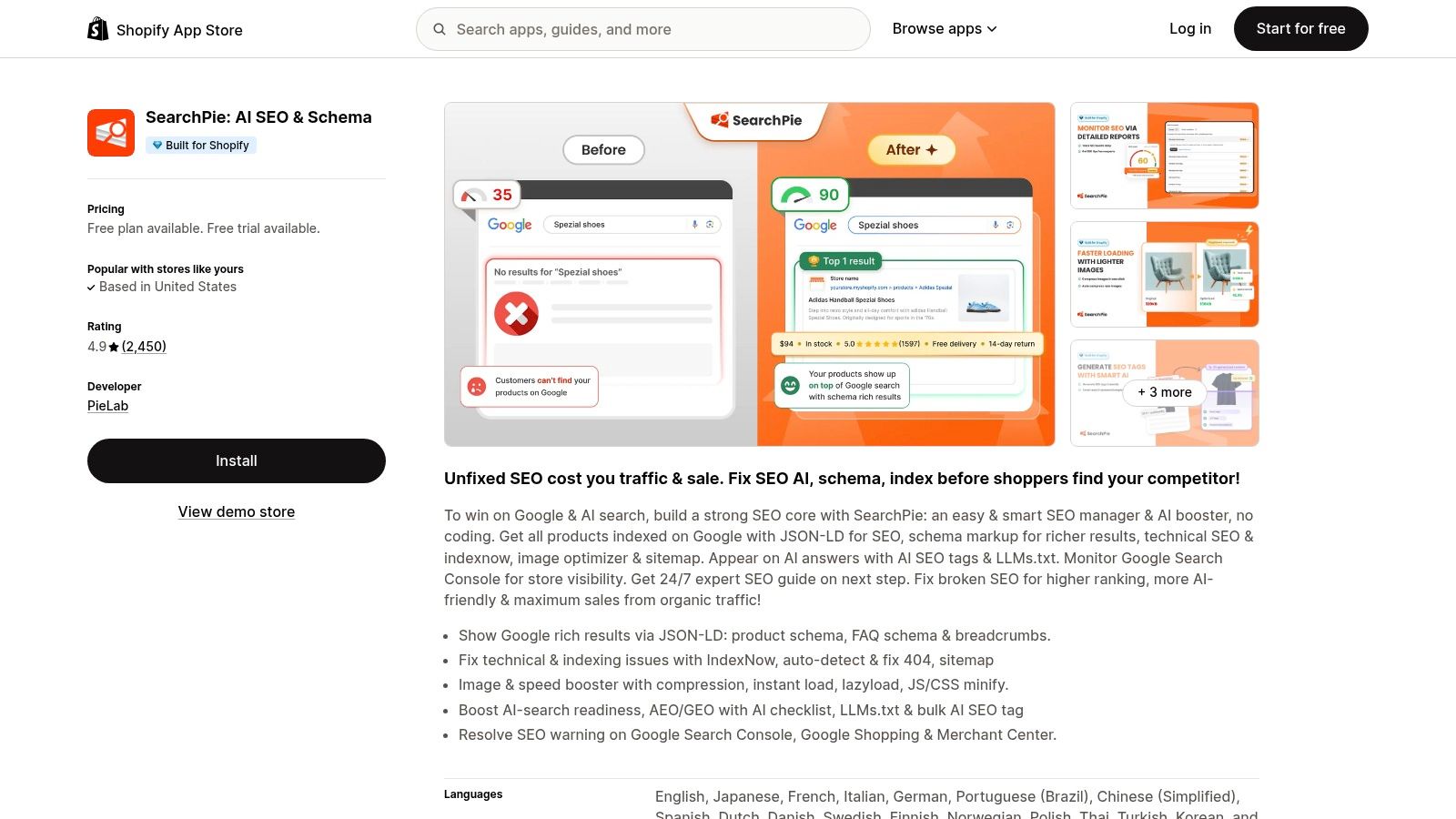
SearchPie suits merchants seeking routine SEO maintenance without building a custom technical workflow. The SearchPie Shopify listing combines audits, bulk metadata, schema, image and speed optimization, indexing features, and AI-generated SEO elements. Certain plans also include AI-search readiness features such as llms.txt.
A practical starting point is a collection with inconsistent descriptions and incomplete image information. Review proposed edits for product accuracy and meaningful differences between similar items before applying them more broadly. Bulk generation is less useful if every product ends up with interchangeable wording.
File publication isn't visibility measurement
Publishing a discovery file is an implementation event. Receiving an accurate citation is an observed search outcome. Track them separately.
SearchPie's readiness features can belong in a store-maintenance workflow, but they don't establish that an AI system has retrieved, trusted, or cited the store. Keep evidence of file availability separate from evidence of brand mentions and referrals.
The app offers a free plan, with expanded schema and AI-search functionality reserved for paid tiers. Verify which page types and features your proposed package supports, especially if the store serves multiple markets or uses customized templates.
Automated fixes also deserve review beyond the dashboard. Check relevant metadata, schema output, redirects, and images on the live storefront.
SearchPie is most useful when the merchant needs a Shopify-native maintenance app. It's not a replacement for detailed backlink research, an editorial optimization platform, or commercial attribution for AI-originated visits.
10. TinySEO
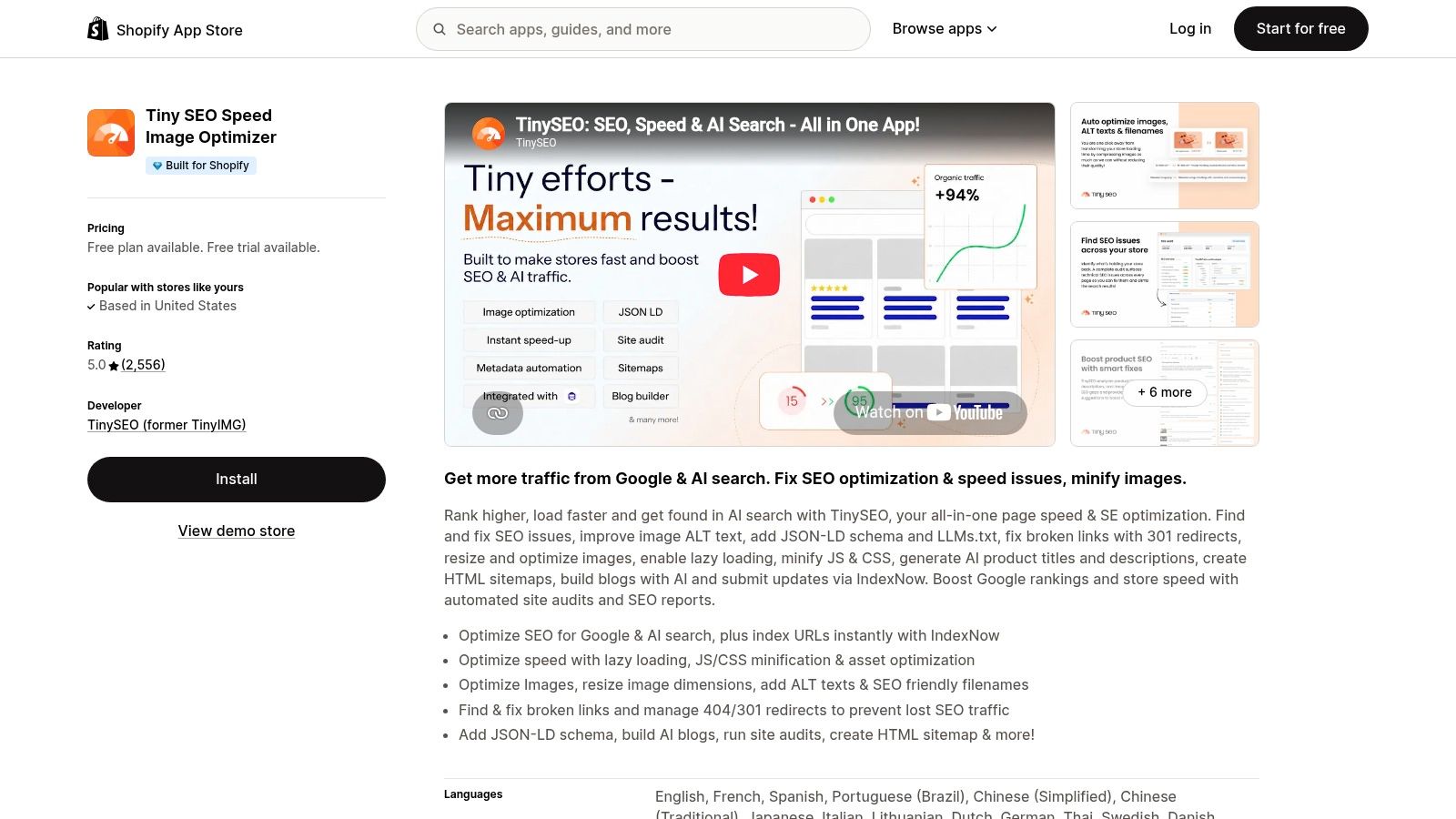
Start with TinySEO when image-heavy catalog maintenance is the pressing problem. TinySEO emphasizes image compression, resizing, alt text, and filename optimization alongside audits, speed tools, metadata, and structured data. Paid tiers add AI-related content and technical capabilities.
For a merchant regularly uploading new product photography, evaluate the continuing workflow rather than just the initial cleanup. Someone needs to review image quality, ensure alt text describes the actual image, and check that newly added assets receive the intended treatment. AI assistance doesn't remove that responsibility.
Compare allowances with your upload workflow
TinySEO has a free-to-install entry point, with image allowances and features varying by plan. Some plans can incur additional usage charges for extra image optimization, so check how the proposed package handles both the existing catalog and future uploads.
- Primary fit: Image optimization, practical storefront maintenance, and associated SEO tasks.
- Tier-dependent additions: AI metadata, IndexNow, broken-link handling, and discovery files such as llms.txt and agents.md.
- Important boundary: Optimization features aren't equivalent to a full AI-visibility measurement suite.
Avoid running overlapping image or schema automation without deciding which app owns each function. A clear division of responsibilities makes testing and troubleshooting more manageable.
TinySEO is a focused candidate when media maintenance consumes merchant time. If the store already has an effective image workflow, buy it only if the remaining supported tasks justify another app, rather than because its plan includes AI features.
Top 10 AI SEO Tools: Feature Comparison
| Product | Core SEO Strengths | Shopify Execution & Verification | AI-Search Capabilities | Best For | Price / Quality Signal |
|---|---|---|---|---|---|
| 🏆 RankEngine | Audits, schema, content, rankings, technical SEO | Shopify-native fixes; reads live values to verify supported changes; eligible edits can be undone | Tracks ChatGPT, Claude, Gemini, and Perplexity; supports llms.txt and agent files |
👥 Merchants wanting verified fixes and SEO/AEO in one workspace | 💰 $19/mo Basic; $59/mo Pro; 3-day trial; ★ 5.0/5 (10 reviews) |
| Semrush | Keyword, competitor, site-audit, and rank research | No direct Shopify fixes or verification | AI visibility and prompt tracking vary by plan | 👥 SEO and marketing teams needing broad research | 💰 Limited free tier; paid plans vary |
| Ahrefs | Backlink, keyword, competitor, and technical research | No direct Shopify fixes or verification | Brand Radar and AI prompt tracking, depending on plan | 👥 SEO specialists focused on links and competitors | 💰 Free Webmaster Tools; paid plans can be costly |
| Surfer | Content optimization and audits | No Shopify catalog-wide technical fixes | AI visibility analytics and prompt tracking | 👥 Editorial teams optimizing content | 💰 7-day trial; AI features vary by plan |
| Frase | Topic research, drafting, and content scoring | Shopify publishing not listed in reviewed material | SEO and AI-search content scoring; page monitoring | 👥 Teams producing blogs and guides | 💰 7-day trial; limits vary by plan |
| seoClarity | Enterprise SEO, technical audits, rankings, and automation | Shopify workflows may need integration or setup | AI citation, prompt, bot, and shopping visibility | 👥 Large brands and agencies | 💰 Custom enterprise pricing |
| StoreSEO | Product metadata, images, schema, and indexing | Shopify app; review live-store changes after tasks | MCP connection for Claude and ChatGPT | 👥 Shopify merchants seeking routine SEO and AI-assisted workflows | 💰 Free plan; ★ 5.0/5 (763 reviews) |
| Avada AI SEO Image Optimizer | SEO audits, images, speed, schema, and redirects | Shopify-focused optimization; review theme and store changes | AI tools on higher tiers; limited multi-engine visibility measurement | 👥 Stores wanting SEO, image, and speed tools together | 💰 Free plan; ★ 4.9/5 (~4,660 reviews) |
| SearchPie | Metadata, schema, images, speed, and indexing | Shopify-native bulk SEO tools; review automated changes | AI-generated SEO elements and plan-dependent llms.txt |
👥 Merchants seeking broad routine SEO automation | 💰 Free plan; ★ 4.9/5 (~2,460 reviews) |
| TinySEO | Image optimization, speed, audits, and structured data | Shopify-focused image and SEO optimization | Higher tiers add AI metadata and agent-ready files; no full visibility suite | 👥 Image-heavy Shopify stores | 💰 Free-to-install; ★ 5.0/5 (~2,500 reviews) |
Build the Stack Around the Bottleneck
Choose a primary tool for the workflow that consumes the most merchant time, then add specialists only where they solve a distinct problem. For Shopify implementation and verified AI-readiness workflows, RankEngine is the most focused starting point in this roundup. For backlink research, choose Ahrefs; for broad keyword and competitor analysis, consider Semrush; for editorial optimization, compare Surfer with Frase.
That doesn't mean every merchant needs a research suite, content platform, optimization app, and enterprise visibility subscription. Assign each recurring task to a tool and a human owner. If overlapping apps can generate metadata, inject schema, or modify images, decide which system controls the output before enabling automation.
Verify implementation before judging performance
Test a limited product or collection set before approving catalog-wide changes. Record the original values, review proposed edits against product facts, confirm the live output, and document any remaining theme or developer work. Treat rollback and change history as purchasing requirements, not conveniences.
Keep the performance questions separate from the implementation questions:
- Mention rate: Does the brand appear for the prompts you monitor?
- Citation rate: Does the answer link to your store rather than just naming it?
- Cited-page accuracy: Do the referenced facts match the live catalog?
- Commercial outcomes: Do referral sessions, assisted conversions, and attributable revenue justify further investment?
This separation matters because visibility doesn't necessarily produce a visit. Pew Research Center findings cited in coverage showed traditional-result clicks on 8% of visits with an AI summary, compared with 15% without one (analysis of the AI-search measurement gap).
Respond to a citation gap with diagnosis
If AI visibility rises while organic clicks and attributed revenue don't, inspect the actual answers and cited pages. Are assistants mentioning the brand for relevant buying questions? Are they citing useful product pages, repeating accurate facts, or sending shoppers to third-party coverage instead?
Correct factual conflicts and improve the cited destination before commissioning more copy. Keep prompt sets and observation conditions consistent enough to make comparisons useful, and avoid claiming that an edit caused a citation change without a controlled basis.
A useful AI SEO stack should make every action more verifiable, not just produce more recommendations. Buy tools that help your team move from a documented problem to an approved change, a confirmed live result, and a measured business outcome.
RankEngine brings Shopify audits, supported verified fixes, structured data, and AI-search monitoring into a merchant-focused workspace. Visit RankEngine to evaluate it against your store's most time-consuming SEO tasks, then test supported changes on a representative product set before expanding automation.