 RankEngine
SEO autopilot is a set of rules that audits your store, writes only supported fixes, re-reads the live result, and keeps a restore point for every change. It does not manufacture rankings, build links for you, or decide what your store should sell.
That definition challenges the most popular advice you'll hear, which is to turn autopilot on and let it run everything. A single on and off switch is the wrong mental model. Some tasks are safe to run while you sleep, some need a sample and a person checking the preview, and some should never be automated at all.
Think of it the way you'd brief a merchandising lead. The system can hold the routine work steady, but you still choose the destination, the claims on the product page, and how much new content the store publishes. When a vendor promises rankings from autopilot alone, ask a simpler question first. Can the system show you what it changed, prove the change is live, and undo it cleanly?
Table of Contents
- What SEO Autopilot Means for a Store
- Which SEO Tasks Can Run Without Approval
- How Shopify Autopilot Verifies Each Fix
- Benefits and Risks of Running Fixes at Scale
- Schema and AI Search Autopilot Examples
- Governance Rules Before You Leave It Running
- Start With a Verified First Batch
What SEO Autopilot Means for a Store
Say your store adds a new collection and half the products land without meta descriptions. A few inherit a duplicate title from an import, and one image has no alt text. An SEO autopilot using a rules engine finds those gaps, applies one narrow supported fix per rule, checks the live storefront, and logs the result.
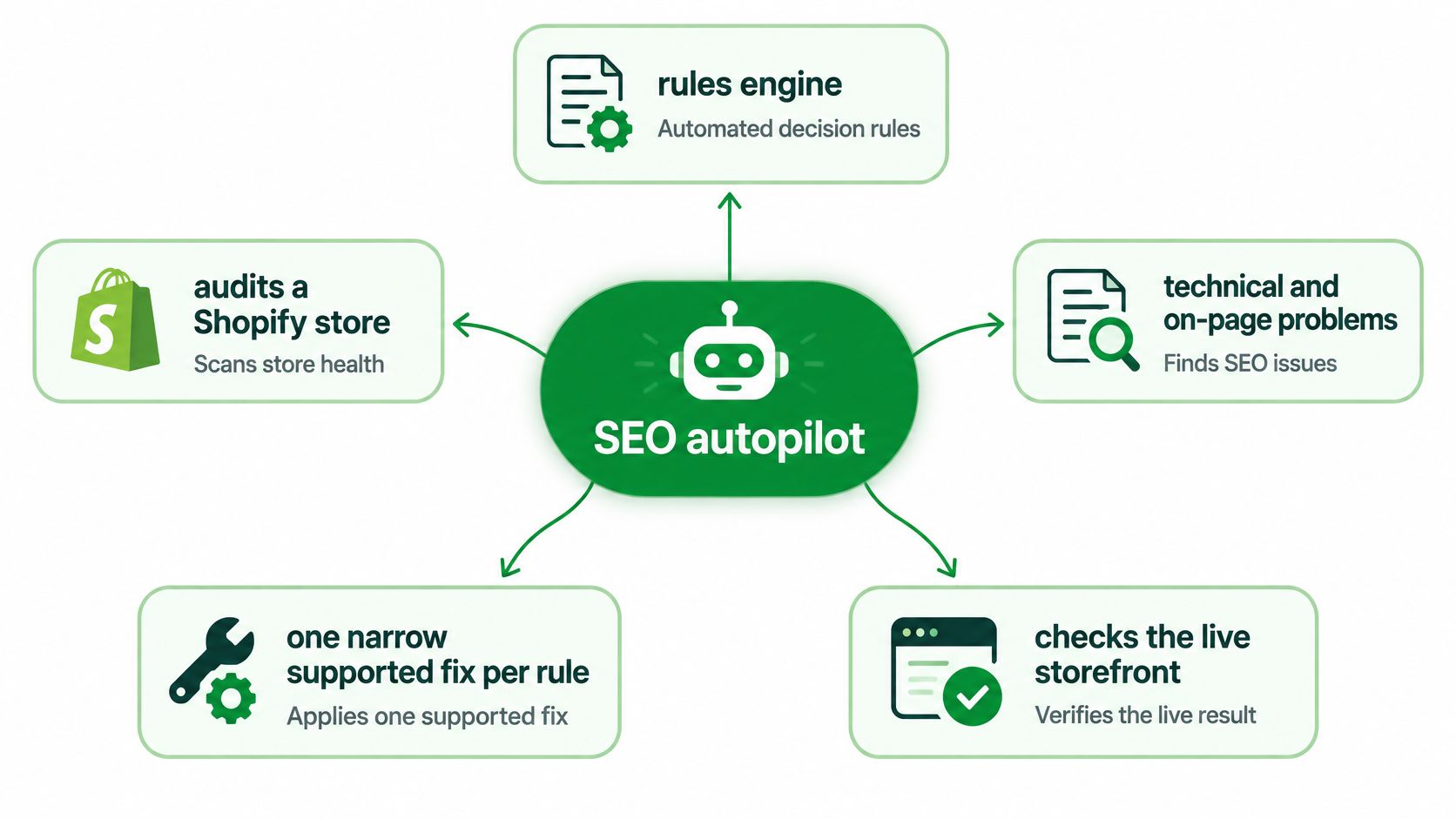
An aircraft autopilot holds altitude and heading. It doesn't choose the destination or invent a runway. Your store version works the same way when it audits a Shopify store for technical and on-page problems you can describe in advance.
Jobs That Fit the Boundary
- Metadata gaps: Missing or duplicate title tags and meta descriptions
- Image gaps: Missing alt text on product media
- Index signals: Canonical and index flags that can be checked against the live page
- Structured data: Validated Product and breadcrumb schema built from catalog records
- Store health: Broken URLs, sitemap errors, and monitoring after a change
That list is a boundary, not a feature parade. If you want a plain explanation of the wider idea, how automated business processes work is a useful primer on rule based workflows outside SEO.
Jobs It Must Never Take
Automated link building sits outside the boundary. So do unpermitted automated queries to Search and mass publication of low value pages. Google's spam guidance treats using automated programs or services to create links as link spam, as explained in Google's report on fighting search spam.
Autopilot improves measurable store quality. It doesn't promise rankings.
The next decision is sorting every job into fully automatic, restore point, staged approval, manual, or prohibited.
Which SEO Tasks Can Run Without Approval
| Action | Typical examples | Who approves | Failure if wrong |
|---|---|---|---|
| Monitoring and reporting | Rank checks, crawl errors, citation watches | Fully automatic | No storefront write, only a bad alert |
| Deterministic metadata | Blank or duplicate titles, meta descriptions, image alt text | Autopilot with restore point and live verify | Overwrites intentional merchandising copy |
| Schema from catalog data | Product, breadcrumb, organization JSON-LD filled from Shopify records | Verified autopilot or a sampled batch | Spreads a wrong price or availability across the catalog |
| Indexing controls | Canonicals, noindex, nofollow | Staged approval unless only filling a missing flag | Hides or consolidates the wrong URLs |
| Redirects and internal links | 301 targets, broken-link fixes, suggested internal links | Staged approval | Sends equity or shoppers to the wrong page |
| Content and publishing volume | Product claims, blog drafts, how many pages to publish | Manual only | Scaled low-value pages |
| Link building | Buying, exchanging, or auto-creating links | Prohibited | Treated as link spam and any credit can be neutralized |
Safest Tier First
Monitoring and reporting can run fully automatic because nothing writes to the storefront. A rank check, crawl error alert, or citation watch can be wrong, but a wrong alert doesn't change a product page a shopper sees.
Deterministic metadata comes next, and only under conditions. A blank title, a duplicated meta description, or missing alt text has a known previous value, often empty, and a predictable replacement from a template. That fix can run on autopilot when there's a restore point and a live re-read. Without those two controls, it's just bulk editing with nicer branding.
Schema sits in a tighter band. Filling a missing field from the Shopify record is safer than rewriting a block the theme already outputs. Sample the batch, or require staged approval, because one wrong price or availability value can repeat across every matching product.
Where a Person Must Stay in the Loop
Canonicals, noindex, and nofollow deserve staged approval unless the rule only fills a missing flag. A wrong canonical tells Google to consolidate the wrong URL. A stray noindex can hide a collection you meant to sell from.
Redirects and internal links need the same caution. A bad 301 target sends equity and shoppers to the wrong page. A bulk internal link rule can bury the products your merchandising team is trying to push this season.
Product claims, positioning, and publishing volume stay manual only. Automated link building isn't reviewed, it's prohibited. OGTool's B2B SEO agent guide is helpful background here because it shows how agent setups separate supervised actions from autonomous ones, even outside Shopify.
A single on and off switch fails because one rule can rewrite hundreds of titles while ranking movement may take weeks to appear. By the time you notice, the batch is old news in the admin. A risk based model built on reversibility and business risk is the stronger framework, as set out in Konvart's guide to SEO automation. Google's concern with scaled content is low value pages whether a person or a model wrote them.
Practical rule: If you can't name the previous value and undo the batch, the rule isn't autopilot safe.
How Shopify Autopilot Verifies Each Fix
Verification is where SEO Auto Pilot either earns trust or loses it. The diagram below shows the shape of the process before the detailed steps.
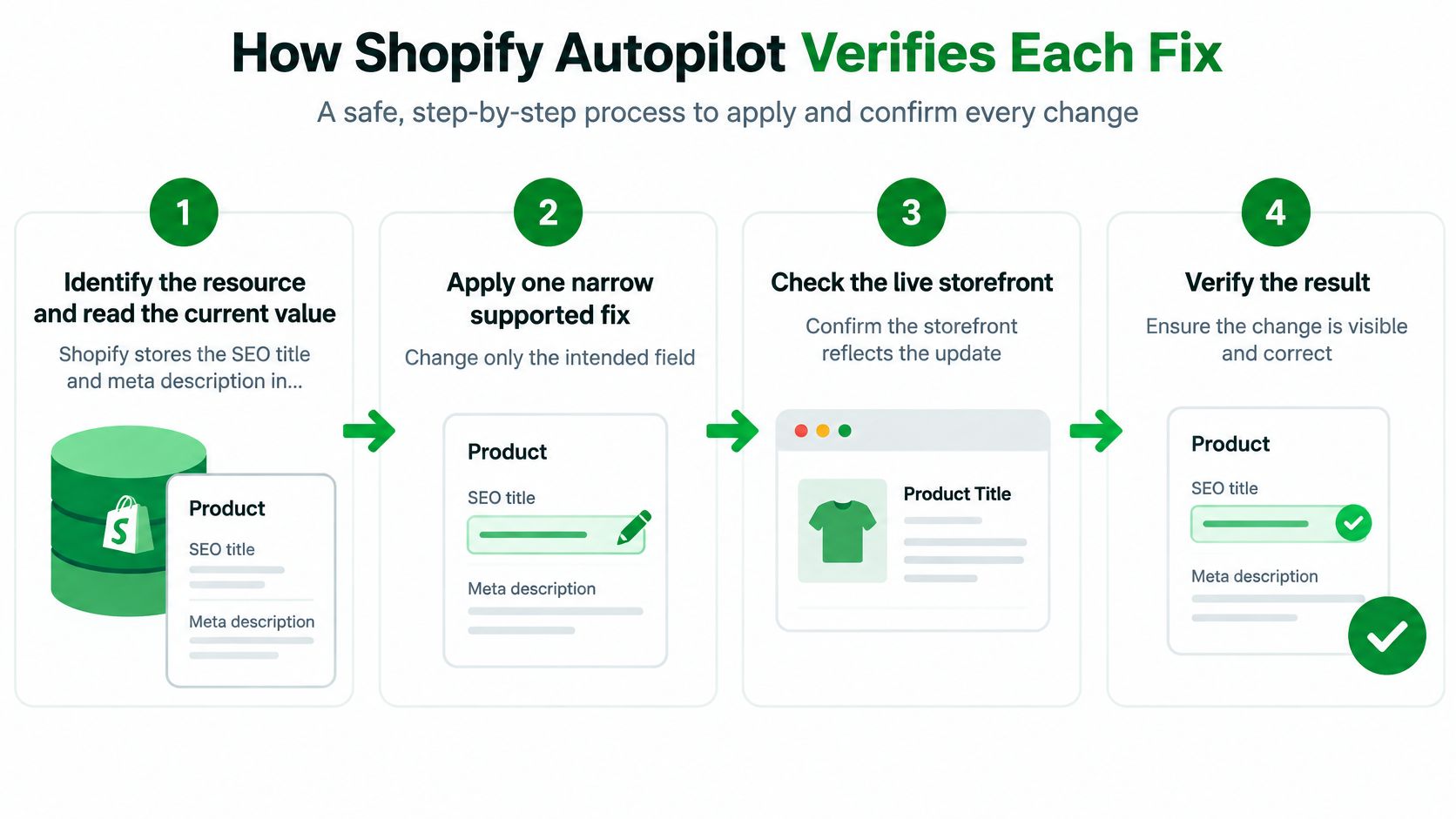
Take one running example, a product with a blank SEO title. A reliable system treats the fix as a write then read transaction, not a fire and forget API call.
The Six Steps
- Identify and read: Find the product resource and read its current value. Shopify stores the SEO title in the global.title_tag metafield and the meta description in global.description_tag, both as single_line_text_field.
- Record before writing: Hash the proposed value and store the previous value with a timestamp. The hash lets the system recognise the same job if it runs again.
- Write through the API: Send the new title through the GraphQL Admin API.
- Re-read the metafield: Read global.title_tag again and compare it with the proposal.
- Inspect the rendered page: Fetch the live product page and confirm the theme outputs the new title in the HTML.
- Mark done only on a match: The job completes only when the post write value matches the proposed value.
Step five is the one people skip, and it's the one that catches real failures. An API write can succeed while the live page stays unchanged. A theme override might hard code titles, an app block might inject its own tags, a cache might serve old HTML, or another SEO app might win the conflict. The dashboard says success, the shopper facing page says otherwise.
This write, re-read, and rendered page pattern follows Shopify's documentation on optimizing storefront SEO, which also covers resource level controls that generate noindex and nofollow directives. Those directives need the same treatment. Write the control, re-read it, then confirm the theme outputs the directive you intended. Our own notes on this layer sit in our guide to Shopify technical SEO checks and fixes.
The video below walks through why checking the rendered result matters in practice.
Why Idempotency and Restore Points Matter
Idempotency means running the same rule twice doesn't stack a second title or duplicate a fix. The stored hash tells the system the work is already done, so a retry after a transient failure is safe.
A proper restore point keeps four things:
- Previous value: The exact title or description before the change
- Resource ID: Which product, page, or collection changed
- Namespace and key: For example, global and title_tag
- Originating rule: Which rule made the change, so a bad batch reverses as a batch
With those fields stored, nobody reconstructs metadata by hand after a mistake. We built RankEngine to follow this pattern, so a fix doesn't reach done status on the API response alone.
Notice the audit starts in Shopify, not with a crawl. Product, variant, media, and publishing data already live in the admin alongside SEO metadata. Crawling every URL as the first source of truth is slower and more fragile than reading the records the store already trusts.
Benefits and Risks of Running Fixes at Scale
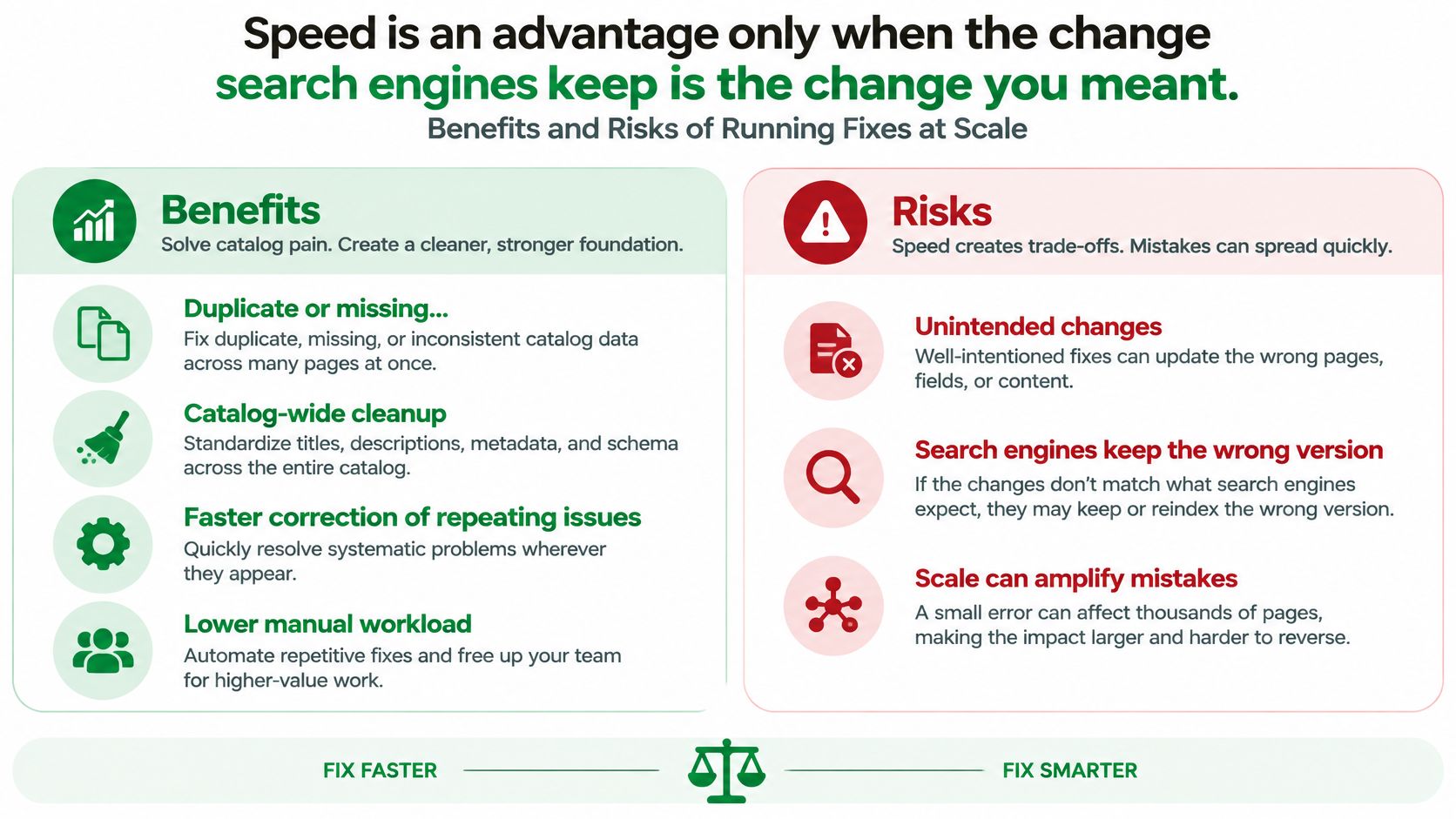
Speed is an advantage only when the change search engines keep is the change you meant. That sentence is the whole trade, and the graphic below puts both sides side by side.
Three Benefits Worth Having
Duplicate or missing metadata across thousands of products causes cannibalization, where your own pages compete with each other. A verified batch standardizes titles, descriptions, and H1s without opening every admin page by hand.
Broken or absent schema blocks rich result eligibility. Generating JSON-LD from the product record and validating it is faster and more consistent than hand edits across a catalog.
Logs and undo give a small team an audit trail. You can see what changed, when, and under which rule, instead of reconstructing history from memory. Our roundup of AI SEO tools for Shopify stores compares how different tools handle that evidence layer.
Three Ways Scale Goes Wrong
An app and the theme can both emit schema, creating duplicate markup that confuses parsers. A wrong shipping promise in a template replicates on every matching product before anyone reads it. And a green dashboard after a batch isn't proof of gain, because ranking effects can lag by weeks.
The cautionary milestone comes from Google's December 2022 link spam update, powered by SpamBrain, its AI based spam prevention system. Google said the update would roll out globally across all languages over approximately two weeks, and that when unnatural links were neutralized, any ranking credit previously passed by those links would be lost.
The system was built to identify sites buying links and sites created to pass outgoing links. Spam detection runs constantly, and announced updates are only the visible part.
Unverified bulk work isn't a shortcut. It's a liability that can be discounted later.
Schema and AI Search Autopilot Examples
Say a sneaker product page looks fine to a shopper but contradicts itself underneath. The rendered price shows the sale price, while the JSON-LD carries the compare at price. The Offer URL points to a non canonical variant link. A sold out size is marked in stock in the markup.
The Broken Page
A safe autopilot flags those three contradictions instead of papering over them. The price mismatch means search engines see one price and shoppers see another. The wrong Offer URL sends signals to a URL you didn't choose as canonical. The false availability can put an unavailable size in front of buyers.
It also refuses one tempting fix. If the catalog has no review data, the system doesn't invent a review count to make the schema look richer. Fabricated values are how a small catalog error becomes a store wide trust problem.
The Same Page After a Correct Run
Now the Product markup comes straight from the Shopify record. Currency and availability are typed correctly, variant relationships stay intact, and the visible price matches the structured price.
The system stores a before and after snapshot with the page URL, schema type, validation result, and re-check time. If anyone asks what changed on that sneaker page, the answer is a record, not a guess.
Google identifies Product and ProductGroup markup as relevant ecommerce structured data, and product markup can make price, availability, shipping, and review information eligible for richer search presentations, according to Google's ecommerce structured data guidance. Google also states that combining webpage structured data with a Merchant Center feed helps maximize eligibility and helps Google verify product information. For the Shopify specific setup, our guide to Shopify schema markup by page type covers which types belong where.
Eligibility Is Not Citation
Valid JSON-LD is not a rich result, and a rich result is not an AI citation.
That gap is where many merchants get confused. Adding schema or an llms.txt file makes facts reachable, but it doesn't guarantee retrieval, recommendation, or citation by an assistant. BrightEdge analyzed tens of thousands of prompts across ChatGPT, Perplexity, and Google's AI systems and found that citation and brand selection patterns differ by engine, as reported in BrightEdge's AI search insights on brand recommendations. You can't infer assistant visibility from traditional rankings or from the presence of markup alone.
So the operational checks change. Which product facts are missing from machine readable pages? Do assistants describe your price, availability, variants, and shipping consistently? When they answer a buying question, do they cite your store or a third party?
Ambiguous cases, such as missing reviews or conflicting variant data, go to a manual queue rather than getting an invented value. Crawler access and AI facing files make your facts available. They don't promise an assistant will use them.
Governance Rules Before You Leave It Running
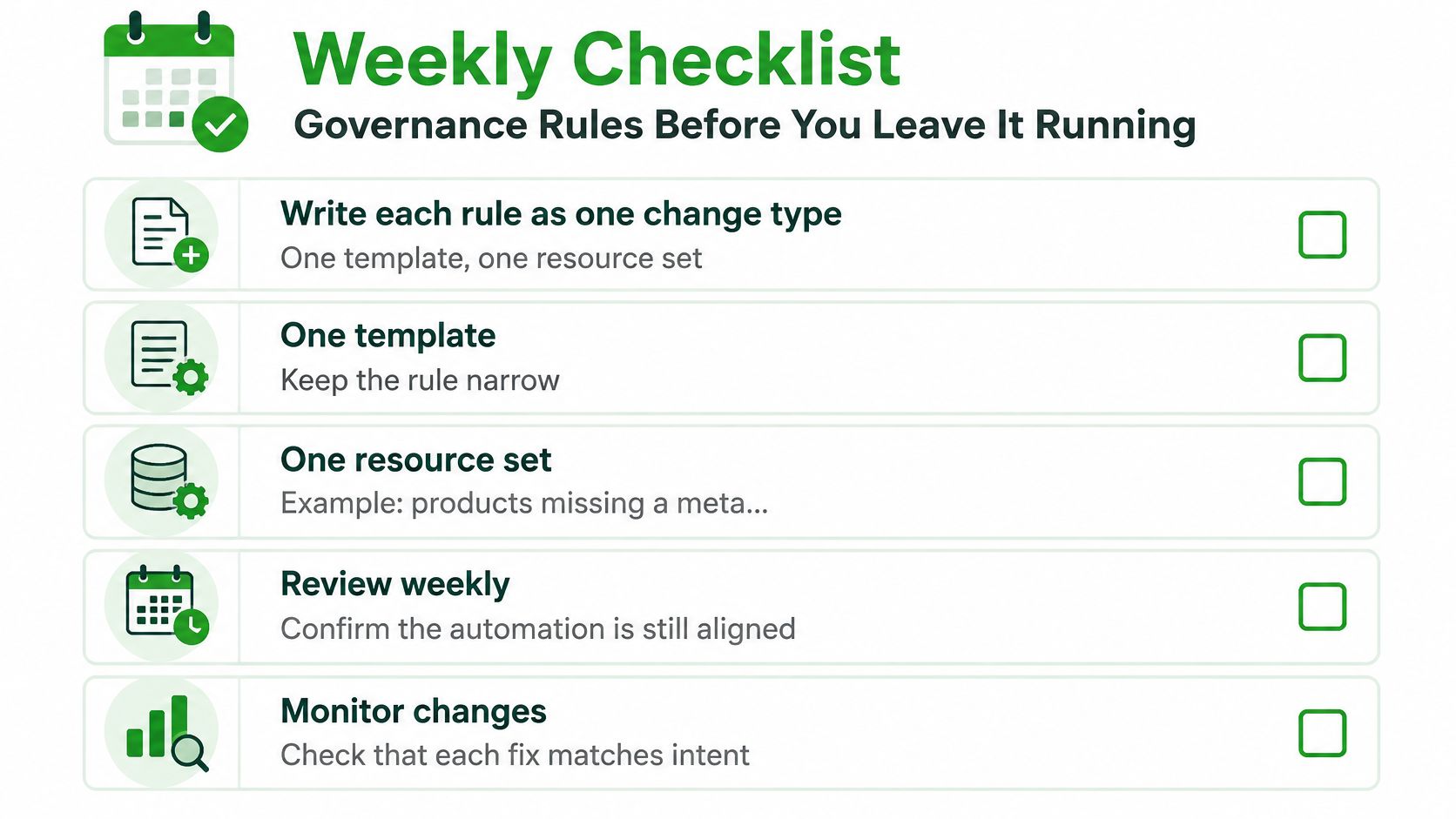
Governance sounds heavy, but in practice it's a weekly operating checklist. The graphic below shows the rhythm in its simplest form.
Ten Working Rules
- One change type per rule: Write each rule as one change type, one template, and one resource set, such as products missing a meta description in one collection. Narrow rules are easier to blame and undo.
- Preview as a shopper: Read a sample of 10 to 20 URLs before shipping, watching for truncated titles, overwritten campaign copy, and duplicate H1s.
- Ship the sample first: Confirm the live re-read on the sample, then expand to the full set.
- Keep an audit log: Record rule name, resource, old value, new value, and timestamp for every change.
- Prove rollback early: Test undo on the sample before trusting a catalog wide run. An untested restore point is a hope, not a control.
- Separate the manual queue: Claims, redirects, and anything the catalog can't support with a real value wait for a person.
- Watch outcomes for weeks: After each batch, check Search Console coverage, index status, and rank or citation movement for several weeks instead of declaring success on fix count. A clean SEO reporting tool comparison from Keyword Kick shows what readable post change reporting looks like without enterprise clutter.
- Re-review after changes: A theme update, a new app, or a seasonal template can break the match between metafield and rendered HTML, so re-check rules after each one.
- Cap publishing by hand: A person decides how many new pages the store creates, not a schedule the tool set for itself.
- Keep link building off the list: It never joins the rule library, under any label.
Ownership stays simple. A merchant or SEO lead owns the rule library, and the autopilot owns execution and evidence. This groundwork doesn't replace strategy, content judgment, or off site authority, and it isn't meant to.
A rule without a sample, a log, and a tested undo is not ready to run overnight.
Start With a Verified First Batch
| Capability | Generic automation | RankEngine verified autopilot |
|---|---|---|
| Done signal | API success or an improved score | Live Shopify value re-read before done |
| Source of truth | Public crawl first | Shopify Admin data first |
| Rollback | Often none | Restore point with prior value and rule |
| Judgment calls | Marked complete anyway | Manual review queue |
| Link building | Sometimes bundled as outreach | Not automated |
| AI search files | Often a separate product | llms.txt, crawler rules, and assistant citation tracking included |
The contrast in that table is the argument. A score going up doesn't prove a shopper facing page changed, and a public crawl can miss what the admin already knows. Verified autopilot starts from Shopify Admin data, confirms the live value, and parks judgment calls where a person can see them.
Your First Batch
Turn on one narrow job. Fix blank or duplicate titles and meta descriptions on a single collection, preview a sample of 10 to 20 URLs, confirm each change with a live re-read, and prove the batch with a tested undo.
Keep three things manual while you learn. Redirects stay manual because targets carry equity. Product claims stay manual because wording carries legal and brand risk. New articles stay manual because publishing volume is a strategy decision, not a maintenance task.
Off site authority stays a human or agency job too, since we don't build links and don't automate that work. On plan limits, Basic allows up to 20 autopilot auto-fix rules, while Pro removes the rule limit and applies verified corrections to title tags, meta descriptions, image alt text, and schema.
The decision to make today is small on purpose. Keep only reversible metadata rules running until one rollback has succeeded, then add schema rules that copy catalog facts rather than invent them.
Start your first verified batch on a single collection, with restore points, live re-reads, and a manual queue for everything that needs judgment. Visit RankEngine to audit your Shopify store, preview a sample of fixes before anything ships, and leave only the reversible rules running overnight.