 RankEngine
A technically clean store can still lose visibility if search engines and AI assistants can't reliably reach, render, and interpret its products. In a 2025 analysis of 25,044 ecommerce sites using the Google Lighthouse API, the average score was 67 out of 100, while 70.5% of sites were rated “needs improvement” (Reboot Online ecommerce SEO statistics). That's a useful reframing: technical SEO isn't a background task for developers. It's the infrastructure that determines whether your products can enter the discovery system at all.
Table of Contents
- Why Technical SEO Decides Whether Your Store Gets Found
- How Search Engines and AI Actually Read Your Ecommerce Site
- Site Architecture and Crawl Budget That Protects Your Best Pages
- Speed Sitemaps Redirects and International Controls Made Simple
- Structured Data That Turns Products Into Machine Readable Results
- Putting It Into Practice With Automated Audits and Verified Fixes
- Your Next Steps to a Faster Healthier and More Discoverable Store
Why Technical SEO Decides Whether Your Store Gets Found
Product work and link building cannot compensate for a store that search systems cannot process reliably. A collection filter may create thousands of low-value URLs, a theme change may hide product details from crawlers, or a canonical tag may point to the wrong product path. Customers following a direct link may see a complete store, while Google and AI assistants encounter a warehouse with blocked aisles.
Large catalogs multiply these risks. Products, collections, variants, filters, sorting options, tracking parameters, and pagination can all create separate URLs for systems to evaluate. Independent ecommerce roundup data found missing canonical tags on 53% of sites, broken links on 62.4%, missing alt attributes on 80.4%, and missing H1 tags on 59.5% (Reboot Online ecommerce SEO statistics). These issues affect how systems consolidate duplicate pages, access images, identify page topics, and choose the product URL to show.
The practical test: A product needs a discoverable URL, renderable content, a clear identity, and a logical connection to its category before it can become a dependable search, shopping, or AI-cited result.
Shopify automates part of this foundation. Platform features support canonical behavior, XML sitemaps, and CDN delivery, reducing routine setup work. Automation does not decide which filtered pages should be indexed, detect conflicting schema injected by an app, or confirm that a new theme keeps product information available without relying too heavily on client-side JavaScript.
Technical SEO therefore functions as machine-readability. The same clean routes, verified markup, and accessible content help Google rank pages and help AI assistants identify products they can cite accurately. Sibley Digital's guide to technical SEO offers a useful framework for separating crawl, indexation, performance, and markup checks rather than treating every visibility issue as a content problem.
A healthy Shopify store gives automated systems a clear catalog, reachable priority pages, and information they can verify. The result is broader, more accurate discovery across classic search results, shopping experiences, and answer interfaces.
How Search Engines and AI Actually Read Your Ecommerce Site
A search engine or AI assistant reads your store in stages, much like a librarian building a catalog from a large collection. Each stage answers a different question: Where is the page? Can its content be loaded? Should it be stored? What does it mean?
First, they discover the shelves
Crawling is the discovery stage. Search bots follow links, read sitemaps, revisit known URLs, and request page resources. A product buried behind an unlinked filter, or available only after an interaction a crawler cannot execute, may be difficult to find.
Ecommerce stores make this harder because one product can appear through a category, collection, filtered result, related-product module, or campaign page. Some routes help shoppers. Others create duplicate or thin URL paths that add noise and give systems more versions to evaluate.
Then, they render the page
Fetching HTML does not guarantee that every product detail will be understood. During rendering, systems process scripts and visible content in a browser-like way. Product names, prices, descriptions, images, and availability should remain accessible in the rendered page, rather than depending on an interaction or excessive client-side JavaScript.
Next, they decide what belongs in the catalog
Indexing is the selection stage. Search systems decide whether to store and show a URL, then compare similar pages to identify the strongest canonical source. Consistent internal links, canonical signals, and page content help one preferred product URL stand out when several routes describe the same item.
Finally, they interpret meaning
Structured data works like catalog metadata. Product markup can identify a product's name, image, price, currency, and availability. Breadcrumb markup shows its place in the store hierarchy. Organization data connects the site with its brand, while FAQ or Article markup can clarify supporting content.
The same machine-readable foundation now serves more than traditional search. Shopify's enterprise guidance describes technical SEO as helping stores become easier for search engines and AI agents to crawl, render, understand, and index (Shopify enterprise guidance summarized in the machine-readable product data analysis). Clean HTML, stable URLs, accurate schema, and accessible content can support rankings, shopping results, and AI answers that need reliable product facts.
A healthy product page is legible to machines. Systems can locate it, load it, distinguish it from similar URLs, verify its facts against visible content, and understand how it fits the catalog. Shopify automates parts of this foundation, but themes and apps still need checks for rendering, conflicting markup, and indexable page paths.
Site Architecture and Crawl Budget That Protects Your Best Pages
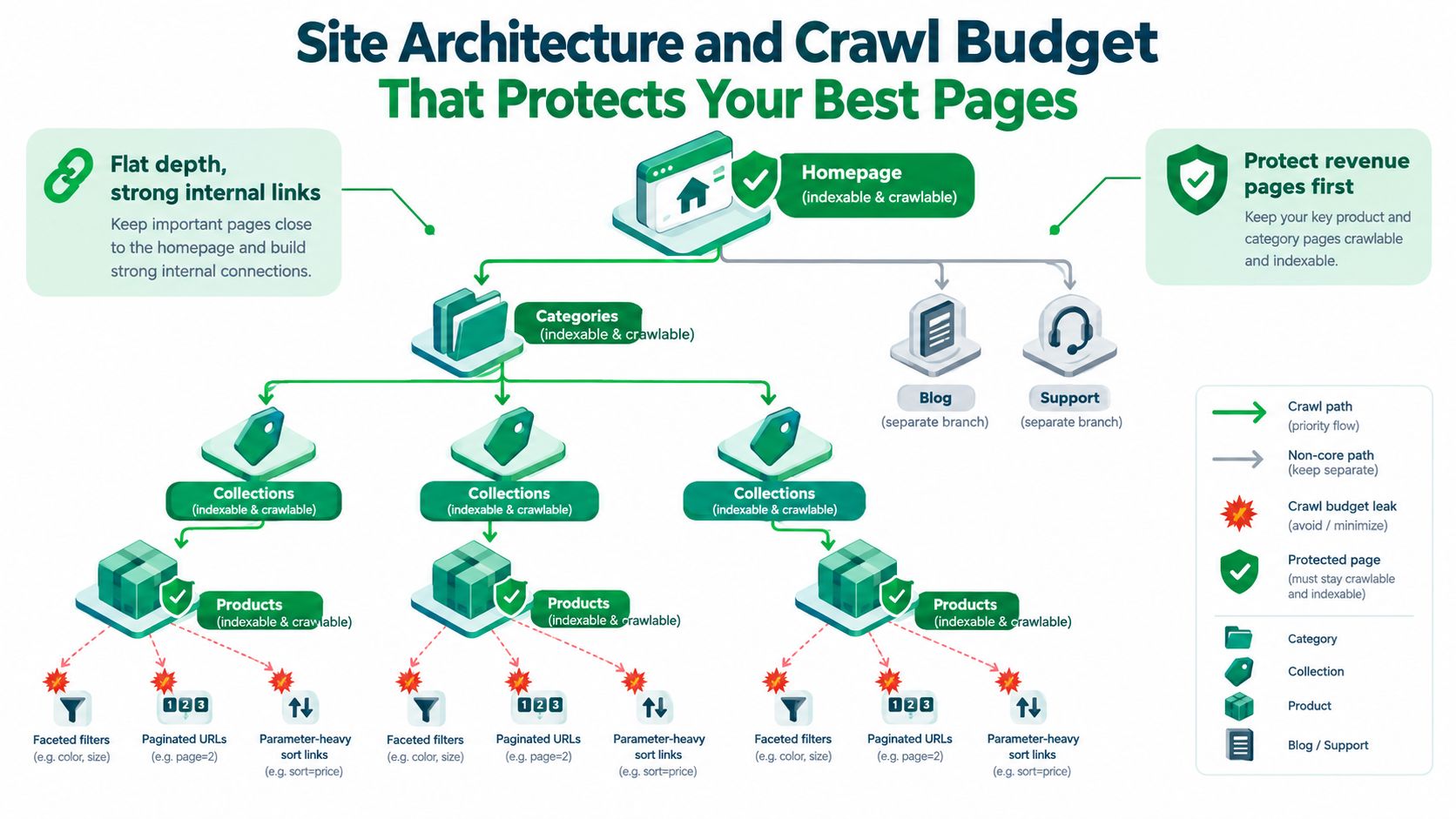
Good ecommerce architecture gives every important page a clear place in the store. A typical route might move from the homepage to a category, then a collection, then a product. Internal links should reinforce that path while also connecting related collections, guides, and priority products.
The structure doesn't need to be perfectly shallow. It needs to be logical, consistent, and supported by links. A new product should not depend on a temporary campaign page or a filter combination for discovery. Link important products from relevant collections, navigation areas, editorial content, and related-product modules where those links help shoppers.
Google defines crawl budget as the combination of crawl rate limit and crawl demand (Google crawl budget guidance via Charle). For a large catalog, the engineering concern is straightforward: low-value URLs can take attention away from canonical products, key collections, and newly launched pages.
Choose the control that matches the problem
A common mistake is treating every duplicate URL with a canonical tag. A canonical tells search engines which version you prefer for indexing and signal consolidation. It doesn't prevent the crawler from requesting the alternate URL, so it doesn't fully protect crawl capacity.
Use the control according to the URL's purpose:
| URL Type | Recommended Control | Why |
|---|---|---|
| Main product or collection URL | Keep crawlable and indexable, use a self-referencing canonical | This is the page you want systems to understand and surface |
| Minor filter or sort variation | Use a canonical to the primary page, and control crawling where appropriate | The variation usually doesn't deserve a separate indexed result |
| Deep facet combinations with little unique value | Use a robots.txt disallow where the pattern is safely defined | Prevents repeated fetching of low-value URL spaces |
| Thin archive or utility page | Use noindex when crawlers can access the page but it shouldn't enter search results | Removes it from index consideration while allowing access to the directive |
| Permanently replaced product | Use a relevant 301 redirect | Transfers users and signals to the closest valid destination |
| Temporarily unavailable product with continuing value | Keep the URL live and make its status clear | Preserves the page as a useful reference instead of creating unnecessary dead ends |
Shopify stores need particular care around collection filtering and product paths. The platform may expose products through collection paths and root product paths, while apps can add parameters for filters, sorting, or merchandising. Crawl the live store, inspect canonical tags, and verify that the URLs in the XML sitemap represent the pages you want indexed.
For a deeper explanation of how crawling, indexing, and ranking interact, see this guide to crawling, indexing, and ranking in SEO. The important distinction is operational: canonicals consolidate preference, noindex controls indexation, robots.txt controls access. None should be applied casually across a pattern without checking how users, internal links, and search systems use those URLs.
Speed Sitemaps Redirects and International Controls Made Simple
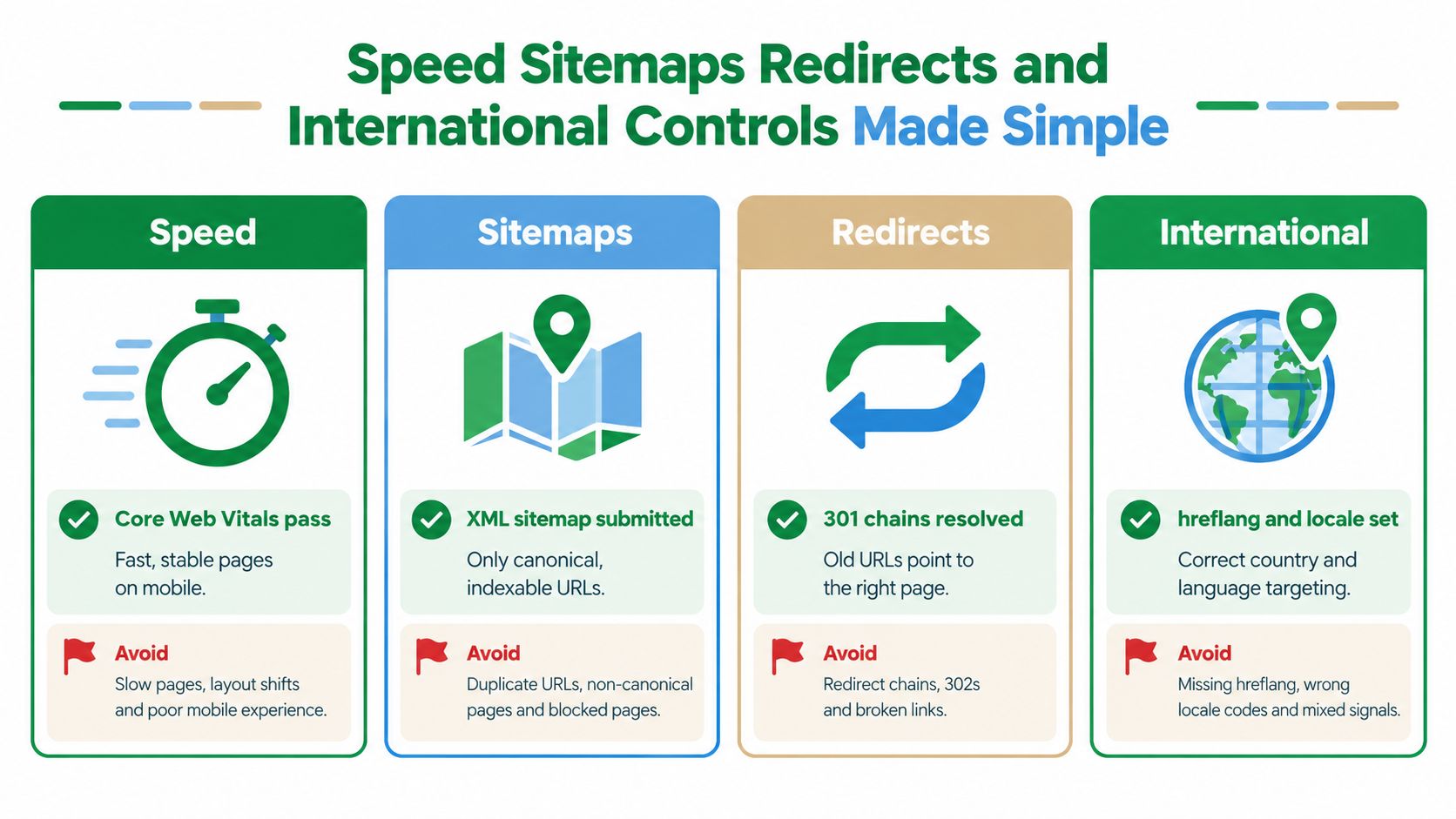
Technical controls work as a connected system. Speed helps users and crawlers access pages. Sitemaps identify the URLs worth discovering. Redirects preserve useful destinations when inventory changes. International signals help systems serve the right regional version.
Speed removes friction before the first interaction
Shopify provides CDN delivery, but storefront speed can still suffer from oversized product imagery, heavy themes, review widgets, chat tools, analytics tags, and apps that inject scripts across every template. Start with the pages that matter commercially, especially the homepage, major collections, and representative product templates.
Use appropriately sized images, reserve space so layouts don't jump, lazy-load images below the fold, and load the main product image early. Measure mobile field data in Google Search Console and use Lighthouse or PageSpeed Insights to investigate individual templates. A fast page isn't just a technical achievement. It lets shoppers see the product and act without waiting for unnecessary code.
Sitemaps and robots.txt define the intended map
Shopify generates an XML sitemap, but automation doesn't guarantee that every listed URL is strategically useful. Review whether sitemap entries resolve successfully, use the preferred canonical, and remain eligible for indexing. Keep robots.txt rules narrow. A broad block that accidentally covers a product or collection path can remove the very pages your sitemap is trying to advertise.
Redirects preserve the trail
Product catalogs change. Handles get edited, products are discontinued, and collections are reorganized. A relevant 301 redirect should take an old URL directly to its closest replacement. Review 404s and redirect chains after migrations, bulk handle changes, and theme or app updates. Redirecting every discontinued product to the homepage creates a poor destination and weakens the relationship between the old and new page.
International signals reduce regional confusion
A store serving different countries or languages needs consistent locale handling. Use dedicated regional or language URLs, accurate visible content, and correctly paired hreflang annotations where applicable. Each regional page should point to its alternatives, and the language or country designation should match what shoppers see.
Operational habit: Treat a theme release or app installation as a technical SEO event. Recheck speed, rendered product content, schema, canonicals, sitemap behavior, and redirects after deployment.
These controls are most effective when reviewed together. A sitemap can't compensate for blocked pages. A redirect can't repair a slow destination. Hreflang can't resolve duplicate content created by uncontrolled parameters. The store needs a coherent set of signals that agree about which pages exist, which pages matter, and who each page serves.
Structured Data That Turns Products Into Machine Readable Results
Structured data gives search engines and AI assistants a dependable layer of explicit facts. It should match the content shoppers can see, so machines can identify the product, offer, brand, and page purpose without guessing.
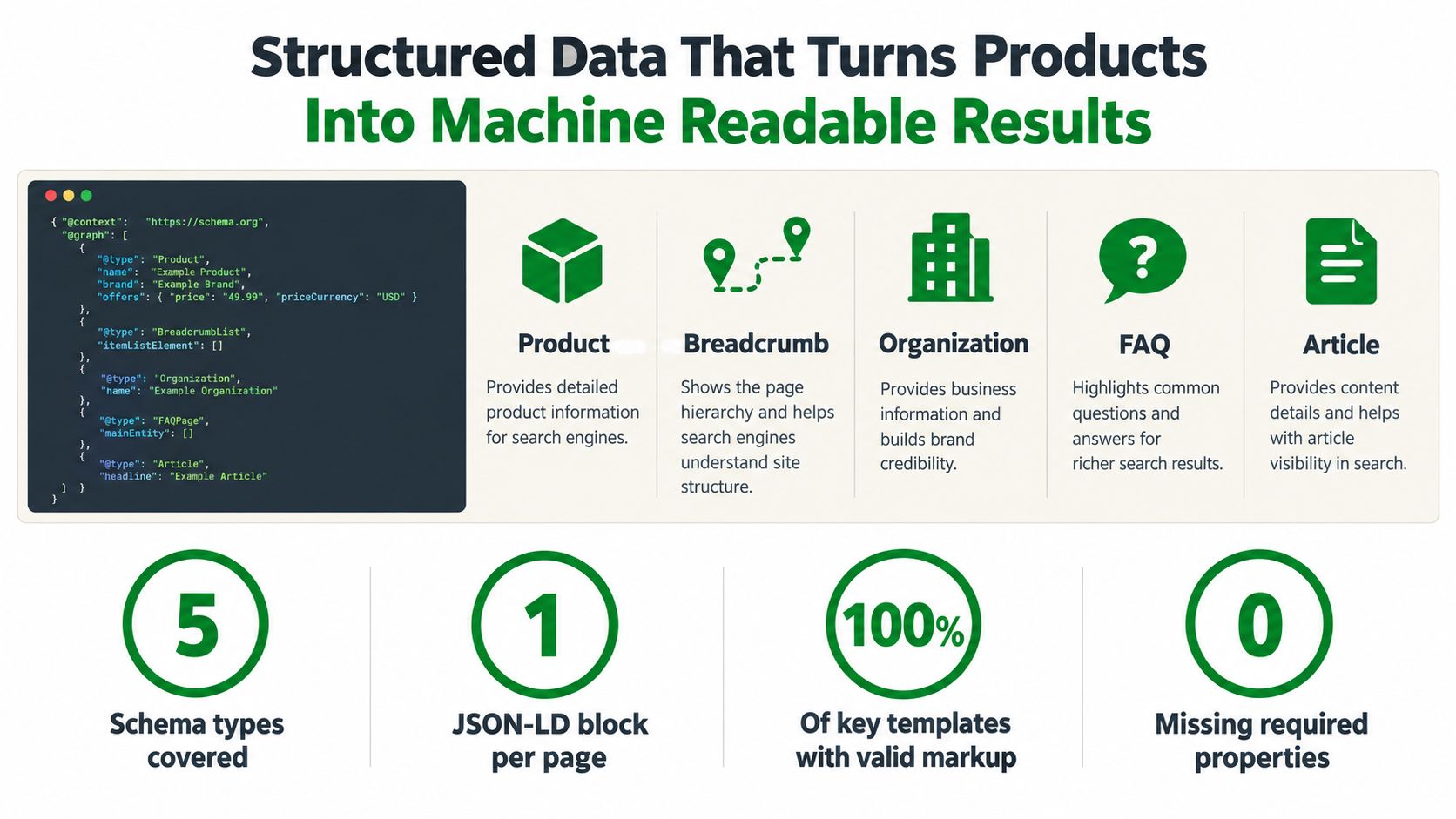
For a product template, Product JSON-LD must describe the item accurately. Google-supported product markup requires the product name, image, and at least one Offer with price, currency, and availability for eligibility for product rich results (ecomSEO product structured data guidance). If the page says an item is unavailable while the markup says it is in stock, the two signals conflict.
Build a connected data layer
A Shopify store can use several schema types, each with a defined role:
- Product: Identifies the item and communicates offers and availability.
- Breadcrumb: Shows the page's position in the visible category structure.
- Organization: Connects the store with its brand identity and official information.
- FAQ: Describes genuine questions and answers displayed on the page.
- Article: Identifies buying guides, educational posts, and editorial content.
Treat these types as connected records, not isolated code fragments. A product can reference its brand, include offer details, and carry breadcrumb context. An article can answer a pre-purchase question and link shoppers to that product. This structure gives machines more context than a product name alone, which helps both classic search features and AI systems interpret the store.
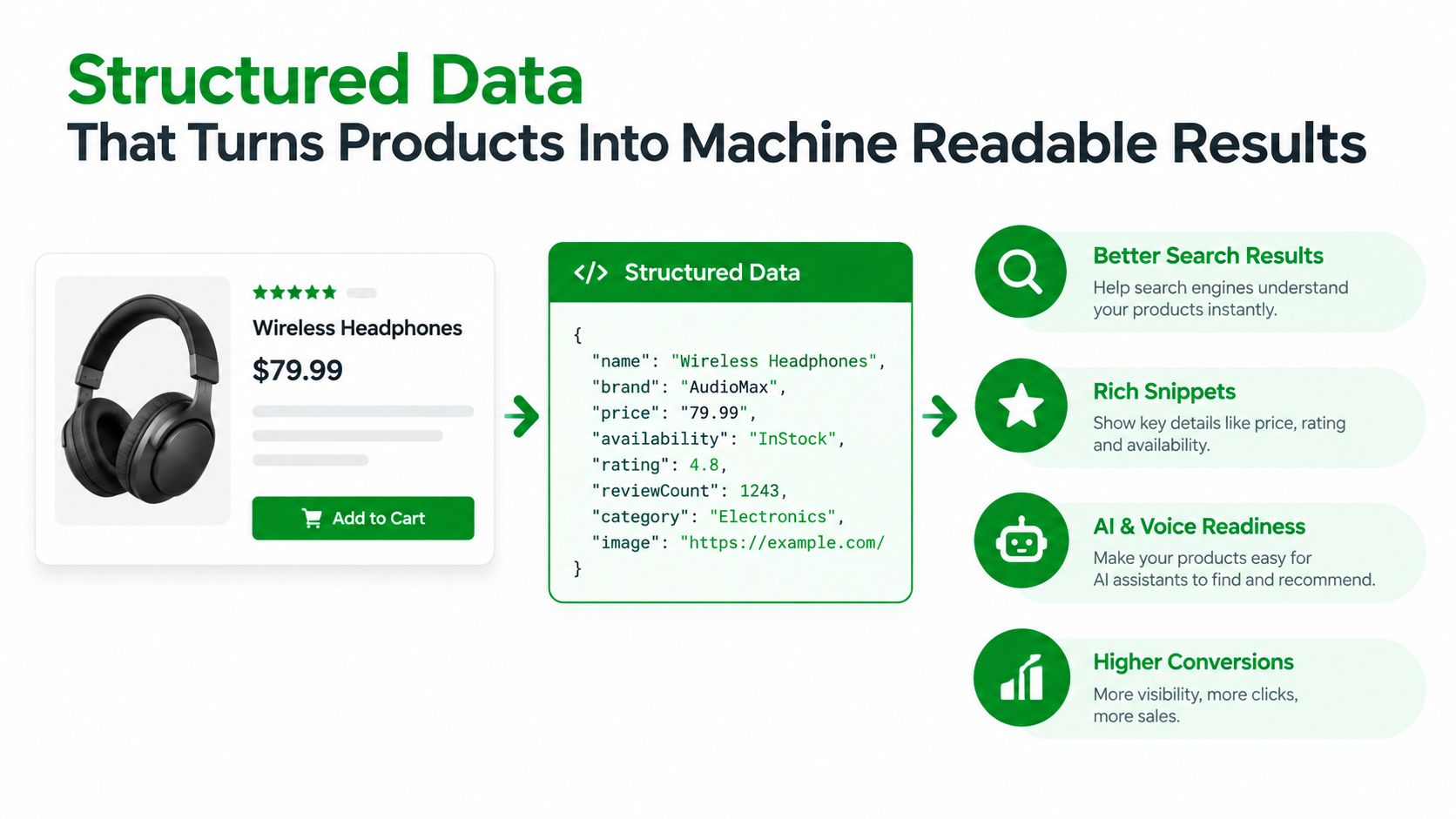
The web now contains far more explicit semantic description than it did in the past. Analysts have documented a substantial increase in structured data adoption over time (Net Solutions analysis of machine-readable product data). That change does not mean every page needs every schema type. It means merchants should maintain structured data as part of the store's infrastructure, rather than add it once as a rich-results checkbox.
Validate what the live page says
A Shopify theme app extension or SEO app can add useful markup, yet duplicated schema is common. A theme, product-review app, and SEO tool might each publish Product or Organization data. Check representative product, collection, article, and page templates. Compare the rendered markup with the visible product name, price, images, reviews, and stock status.
For implementation guidance, see this structured data for SEO resource. Valid JSON-LD can still describe the wrong product, omit needed properties, or disagree with the rendered page, so testing must examine meaning as well as syntax.
AI assistants also need reliable source material. Schema does not guarantee a citation, but accurate markup, crawlable copy, useful internal links, clean feeds, and fast rendering make a Shopify store easier to interpret across search results and answer systems.
Putting It Into Practice With Automated Audits and Verified Fixes
A Shopify audit earns its place when it turns a long issue list into clear decisions. Begin with the store's real objects, not only a crawler's assumptions: products, collections, pages, blog articles, images, redirects, theme output, and structured data. These are the connected parts that determine whether Google and AI assistants can interpret the storefront consistently.
Consider a store with repeated product titles, weak collection headings, inconsistent image alt text, and missing Product markup across part of its catalog. A manual workflow might export records, edit them in batches, change theme code, update a spreadsheet, and assume the publication succeeded. The weak point is the gap between a submitted change and the live storefront.
Compare the two operating models
Manual editing gives a team control over unusual brand decisions. It becomes slower and more error-prone as the catalog grows, templates multiply, or every change requires a post-publication check.
Verified automation applies supported fixes through Shopify's Admin API, then reads the live values again before closing the task. Repeatable rules can handle missing metadata, alt text, canonicals, and structured data. Ambiguous titles, unusual redirects, and editorial choices can move into a manual review queue instead of being changed blindly.
That verification step works like checking a parcel after delivery rather than trusting the dispatch notice. It confirms that the storefront shoppers, crawlers, and machine-reading systems receive matches the intended update.
RankEngine is a Shopify-focused option that combines audits, API-backed fixes with live verification, structured data validation, technical controls, restore points, and AI-readiness files in one workspace. Its workflow treats a successful API response as an intermediate status, not proof that the public page changed.
The broader pattern remains useful: structured data adoption has grown substantially over time. Merchants therefore need an operating process that keeps product facts machine-readable as prices, availability, templates, apps, and catalog records change.
Use this SEO audit example to shape prioritization. Fix blocked or incorrectly canonicalized revenue pages first. Then address template-wide performance and schema defects, followed by lower-risk content and image improvements. Keep restore points, record each change, and recheck the live page so the audit reflects what shoppers, Google, and AI assistants can access.
Your Next Steps to a Faster Healthier and More Discoverable Store
Technical SEO for ecommerce works best as a maintenance routine, not a dramatic one-time cleanup. Start with the pages that generate revenue or support important launches, then expand your checks across the catalog.
Use a practical monitoring rhythm
- Review crawl and indexation signals: Inspect Search Console coverage, URL inspection results, sitemap status, and newly excluded important pages.
- Check performance after change: Test representative mobile product and collection templates after theme releases, app installations, and large image uploads.
- Validate structured data: Recheck Product, Breadcrumb, Organization, FAQ, and Article output when templates or apps change.
- Watch catalog transitions: Review redirects, 404s, discontinued products, out-of-stock handling, and changed handles.
- Audit discovery paths: Confirm that priority products have internal links and aren't reachable only through filters or temporary campaigns.
- Measure machine readability: Check whether visible product facts, feeds, structured data, and AI-readiness files agree with one another.
The priority order matters. A missing description is worth fixing, but it shouldn't outrank a product page that search engines can't crawl or a template that exposes conflicting price and availability data. Clear architecture, accessible rendering, accurate markup, and dependable monitoring give both traditional search systems and AI assistants a reliable version of your catalog.
Choose a small group of important templates today, inspect them live, and document the first issues you find. Then turn those checks into a repeatable process that runs whenever your Shopify store changes.
RankEngine audits Shopify products, collections, pages, images, redirects, internal links, structured data, and AI-search readiness, then applies supported fixes through the Shopify Admin API and verifies the live result. Visit RankEngine to assess your store's machine-readability gaps and build a controlled workflow for fixing and monitoring them.