 RankEngine
You've built a Shopify store with strong products, useful buying guides, and carefully written collection copy. Yet Google still shows a plain blue result, while a competitor's listing displays price, availability, ratings, or a clearer page path. Your product may be just as relevant, but search engines don't receive the same level of explicit information.
The difference often comes from structured data, the machine-readable layer that labels what a page contains. It gives search engines and answer systems clearer signals about products, brands, authors, locations, and relationships between pages. It won't rescue weak content or guarantee a ranking, but correctly implemented markup can make eligible pages easier to interpret and qualify for enhanced search appearances.

Table of Contents
- Why Your Great Content Still Gets Overlooked
- What Structured Data Really Does for Search Engines
- The Six Structured Data Types Every Shopify Store Needs
- How Structured Data Enables Rich Results and AI Visibility
- Implementing and Validating JSON-LD Without Breaking Your Store
- Managing Structured Data at Scale With RankEngine
- Turning Markup Into Measurable Visibility
Why Your Great Content Still Gets Overlooked
A product page can tell a human shopper everything they need. The title says “linen overshirt,” the page displays the price, and the inventory message says the item is available. A crawler can read those words, but reading text isn't the same as confidently classifying each piece of information.
Structured data adds explicit labels. Instead of asking a search engine to infer which number is a price and which sentence describes stock status, JSON-LD identifies those values as properties of a Product and an Offer. The page remains useful to people, while the markup creates a cleaner package for machines.
Practical rule: Mark up facts that are visible, accurate, and tied to the page's primary purpose. Don't add properties simply because a schema generator offers them.
This matters beyond traditional search. Google uses structured data to understand page content and can use eligible markup to create rich results, such as enhanced product listings. AI assistants also need machine-readable signals when they retrieve and compare information, although markup by itself doesn't guarantee that an assistant will cite your store.
The practical path for a Shopify merchant is narrower than the full Schema.org vocabulary might suggest. You need to understand the shared language, choose the types that fit each page, generate JSON-LD from live Shopify data, and validate the rendered storefront. Then you need a way to notice when a theme update, product change, or app conflict breaks the output.
What Structured Data Really Does for Search Engines
A product page may show a name, price, brand, and stock message clearly to shoppers. Search engines still need to determine what each value represents and how the pieces relate. Structured data supplies those labels, much like machine-readable packaging that identifies a product for Google and AI assistants.
It uses the Schema.org vocabulary, a shared system that Google, Bing, Yahoo, and Yandex helped establish in 2011 for adding meaning to web pages. The history and current scale of Schema.org usage traces how this vocabulary developed from a fragmented practice into a broad ecosystem.
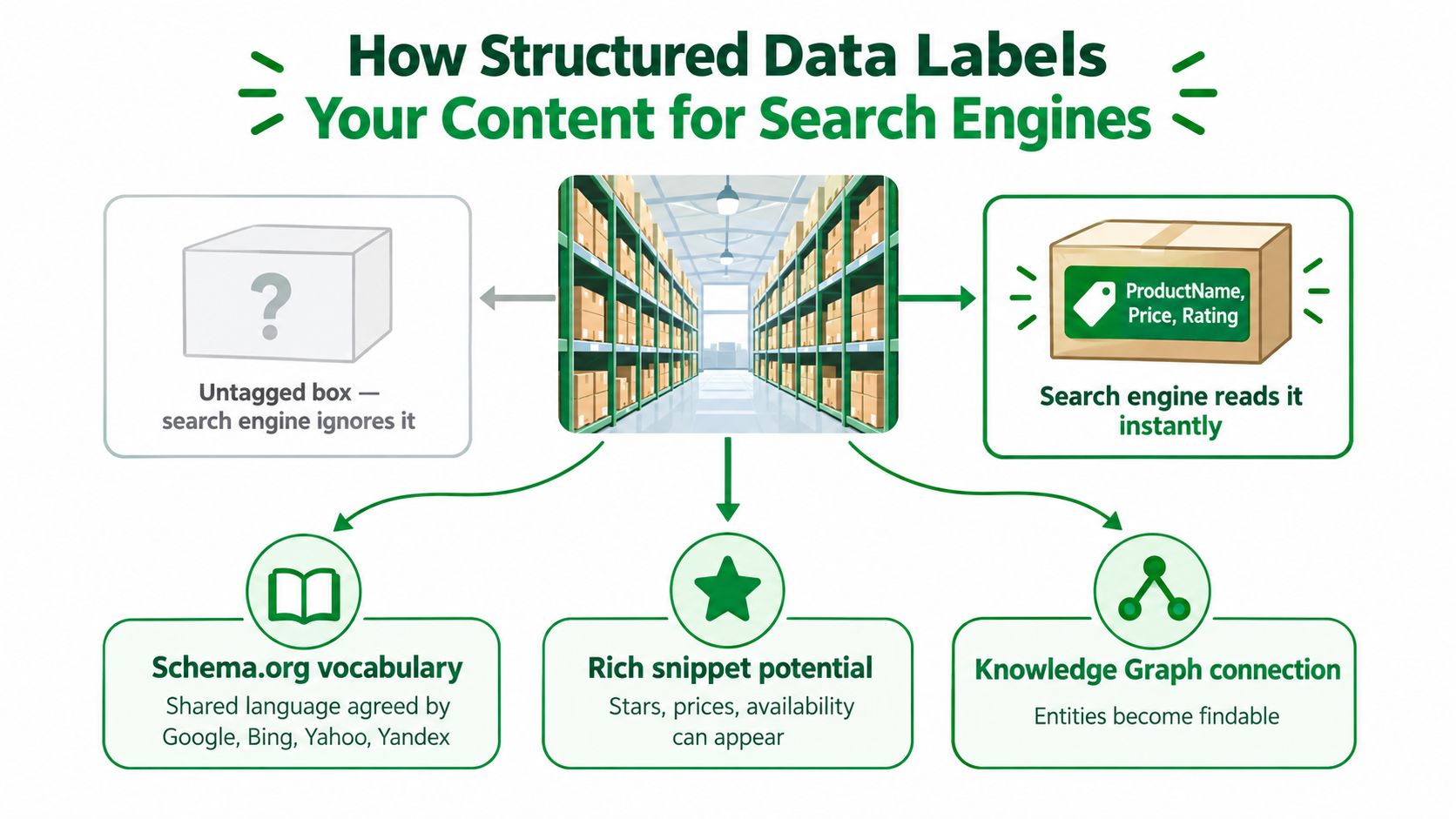
Schema.org is the vocabulary, JSON-LD is the delivery format
Schema.org defines concepts and properties. JSON-LD delivers those labels, usually in a script block separate from the visible HTML. For Shopify teams, that separation makes it possible to connect markup to live product, price, inventory, and brand data without changing the shopper-facing layout. Google recommends JSON-LD and advises merchants to validate markup with the Rich Results Test and live URL inspection before rollout. Google's structured data documentation explains that markup helps Google understand content and can make pages eligible for rich results.
Eligibility is not a ranking promise. Structured data does not replace useful content, crawlability, sound internal linking, or a page that meets shopper intent. It acts as a communication layer, reducing ambiguity about what a page contains.
The vocabulary is far larger than an ordinary store needs. Google's public Schema.org usage dataset for May 2026 reported 958 distinct types and 4,587 properties in live markup, while only 12 schema types appeared on at least 10 million domains. About 77% of tracked types and properties appeared on fewer than 1,000 domains, according to the same structured data usage analysis. That long tail signals a practical rule: unusual types rarely belong on standard Shopify templates.
Choose markup that matches each page and its visible facts. A correct Product object can clarify a product's identity and offer details for search systems, while a large collection of irrelevant properties creates more opportunities for stale or invalid JSON-LD. Unified management also matters, because theme changes, product edits, and app conflicts can break the labels machines rely on.
The Six Structured Data Types Every Shopify Store Needs
Shopify stores usually have several page families, and each family needs different labels. The right approach is to match the schema to the content instead of placing every possible type on every URL.
| Page Type | Recommended Schema | SERP and AI Benefit |
|---|---|---|
| Product page | Product with Offer and applicable review data | Clarifies product identity, price, currency, availability, and eligible review information |
| Blog article | Article or BlogPosting | Connects headline, author, publisher, and publication details |
| Customer questions | Visible FAQ content, with FAQ markup only where eligible | Makes answers clear to users and machines, but rich-result eligibility is restricted |
| Homepage and brand pages | Organization | Establishes business identity, logo, URL, and related entities |
| Product, collection, and article pages | BreadcrumbList | Describes the page's position in the store hierarchy |
| Physical location page | LocalBusiness | Identifies a real-world business and its local context |
Product belongs on product pages
For a Shopify product, the core object should describe the item the shopper can buy. That normally means a name, image, URL, SKU where available, and an Offer containing the current price, currency, and availability. If your page visibly presents ratings or reviews, those details can be represented with the appropriate review properties.
The central point is synchronization. If a variant changes price or goes out of stock, the JSON-LD must reflect the same state as the page. Stale markup creates confusion and can prevent the intended enhancement.
Article supports editorial context
Use Article or BlogPosting for a Shopify blog post when the page has a genuine editorial purpose. The markup can identify the headline, image, author, publisher, and publication dates. It shouldn't turn a thin promotional block into editorial content, and the dates should match the page.
FAQ requires restraint
FAQ content can still help shoppers, especially on product, collection, and support pages. But Google's 2026 changes removed FAQ rich results entirely, retired the FAQ Search Console report, and removed FAQ support from the Rich Results Test, as documented in the analysis of Google's enhancement changes. Treat visible FAQs as customer-facing content, not as a guaranteed SERP feature.
Organization clarifies the store's identity
Organization markup belongs primarily on the homepage or a dedicated brand page. It can connect the business name, logo, URL, and other verified identity information. For merchants, this is foundational because product markup says what you sell, while Organization markup helps explain who sells it.
BreadcrumbList and LocalBusiness complete the structure
BreadcrumbList should reflect the visible hierarchy, such as Home, Women, Shirts, and a specific product. LocalBusiness is appropriate when the business has a genuine physical location or local service presence. Don't use it merely because the store ships to a region.
A schema type is useful only when the page genuinely represents that type and the marked-up information matches what customers can see.
How Structured Data Enables Rich Results and AI Visibility
A Shopify product page can contain excellent copy and still leave search systems guessing about its price, stock status, brand, or product identity. JSON-LD works like machine-readable product packaging: it presents those facts in a consistent format that Google and AI assistants can process. The page still needs valid markup, the required properties for its target enhancement, accessible content, and eligibility for the relevant Google feature. A robots.txt block, noindex directive, login wall, or missing required information can prevent a rich result even when the JSON-LD looks correct.
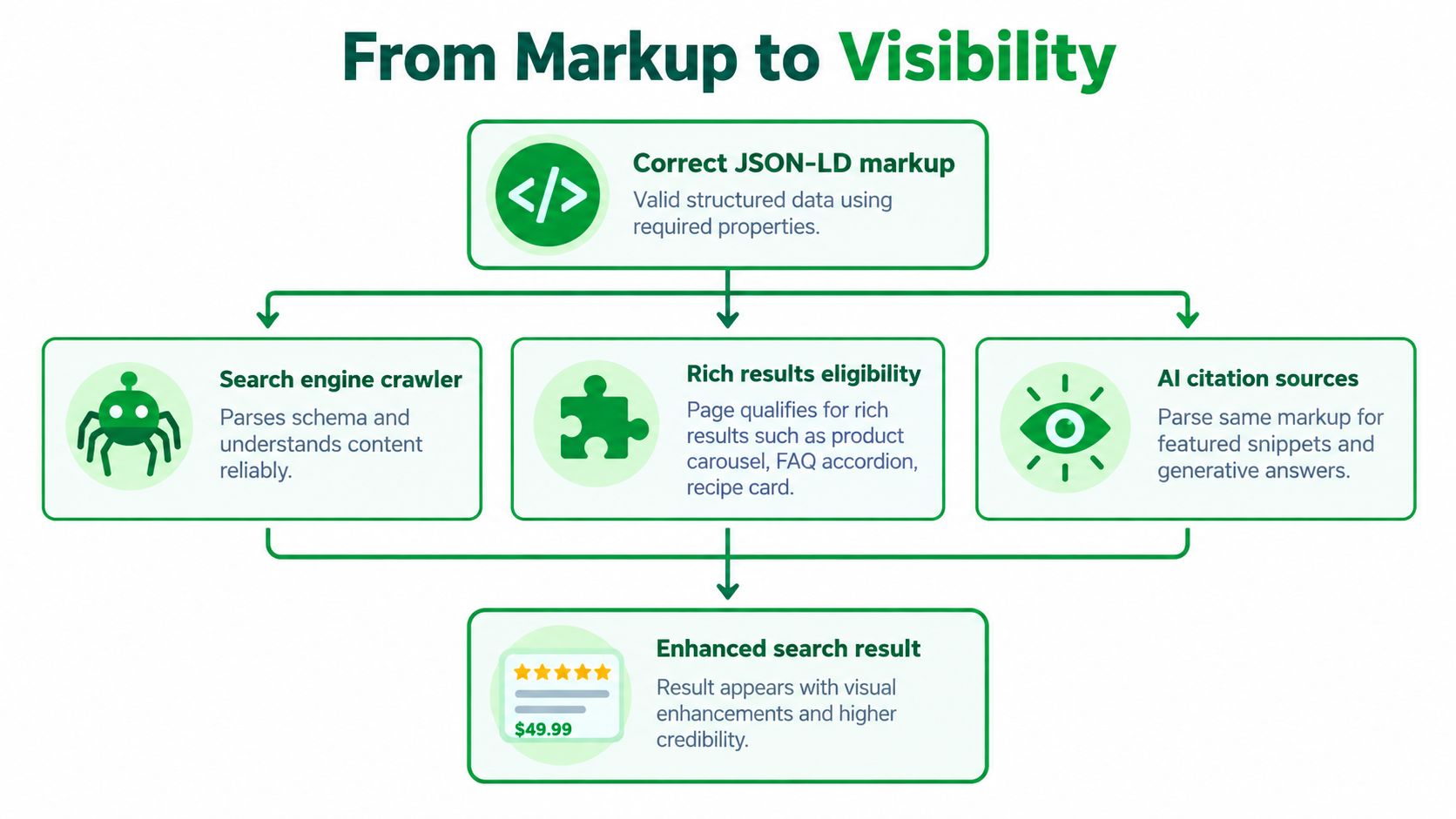
Rich results depend on eligibility
Google explains that structured data helps it understand page content and may enable richer search appearances. Markup is therefore a visibility input, not an automatic ranking lever. Google's case studies show why accurate implementation can matter at catalog scale: Rotten Tomatoes added structured data to 100,000 pages and measured a 25% higher click-through rate on pages with markup than on pages without it. The Food Network converted 80% of its pages to search features and reported a 35% increase in visits. These publisher-specific results are not promises for every Shopify store. The details appear in Google's structured data case studies.
Structured data adoption is also widespread. HTTP Archive data cited in 2026 reported JSON-LD on 41% of all pages in 2024, compared with 34% in 2022, a 7-point increase. WebSite appeared on 12.73% of pages, Organization on 7.16%, and LocalBusiness on 3.97%, according to the schema adoption summary. Many sites start with identity and site-level markup, then add types suited to particular templates.
AI assistants read consistent facts
The same labels can help answer systems identify products, organizations, categories, and article context. Structured data provides a machine-readable baseline for Google and AI assistants such as ChatGPT, Claude, Gemini, and Perplexity.
It does not guarantee a citation. Commentary has reported that AI-cited pages often contain structured data, while a 2026 analysis found no meaningful citation lift from JSON-LD alone. Your store still needs accessible pages, accurate information, strong topical coverage, and evidence that an answer engine can trust.
For merchants working on AI search optimization, the practical question is whether every important product and brand fact is exposed clearly, accurately, and consistently. Unified JSON-LD management helps prevent conflicting objects and silent omissions from weakening that foundation.
Implementing and Validating JSON-LD Without Breaking Your Store
Shopify merchants rarely need to hand-edit every product template. A safer implementation uses the theme and app integration to generate JSON-LD from the same Shopify values that populate the storefront. That keeps the markup connected to product names, images, variants, prices, and stock status.
Start with the page model
Define which template generates each schema type. Product JSON-LD belongs on product pages, Article markup belongs on blog posts, BreadcrumbList should follow the visible navigation path, and Organization markup generally belongs on the homepage or brand page.
Keep the output specific to the page. A product page shouldn't claim to be an article, and a blog post shouldn't inherit a product's Offer because both templates use the same global script.
Generate from live values
The most common silent failures are operational rather than philosophical:
- Missing commercial fields: A Product object may exist while its Offer lacks a current price, currency, or availability.
- Duplicate objects: A theme, review app, and SEO app may each inject Product markup, leaving search engines to reconcile conflicting versions.
- Theme conflicts: A redesigned template can remove or alter the markup block without changing the merchant's SEO settings.
- Content mismatch: JSON-LD describes information that isn't visible, current, or supported by the page.
- Variant confusion: The markup describes one variant while the visible page defaults to another.
Use the Google JSON-LD implementation guide as a technical reference, but test the actual rendered URL rather than trusting the editor or source configuration.
Validate before and after deployment
Google recommends the Rich Results Test for eligibility checks and URL Inspection for the live page. Run both against the rendered storefront, because an app can generate valid code in one environment and fail after theme assets, consent settings, or dynamic content change.
Use this repeatable checklist:
- Confirm visibility: The marked-up product, price, availability, author, or breadcrumb information appears on the page.
- Check syntax: Make sure the JSON-LD parses and the expected schema type is detected.
- Review eligibility: Confirm required properties are present and the page can be crawled and indexed.
- Inspect the live URL: Test the published page, not only a preview or theme editor.
- Monitor regressions: Recheck after theme updates, catalog imports, review-app changes, and pricing campaigns.
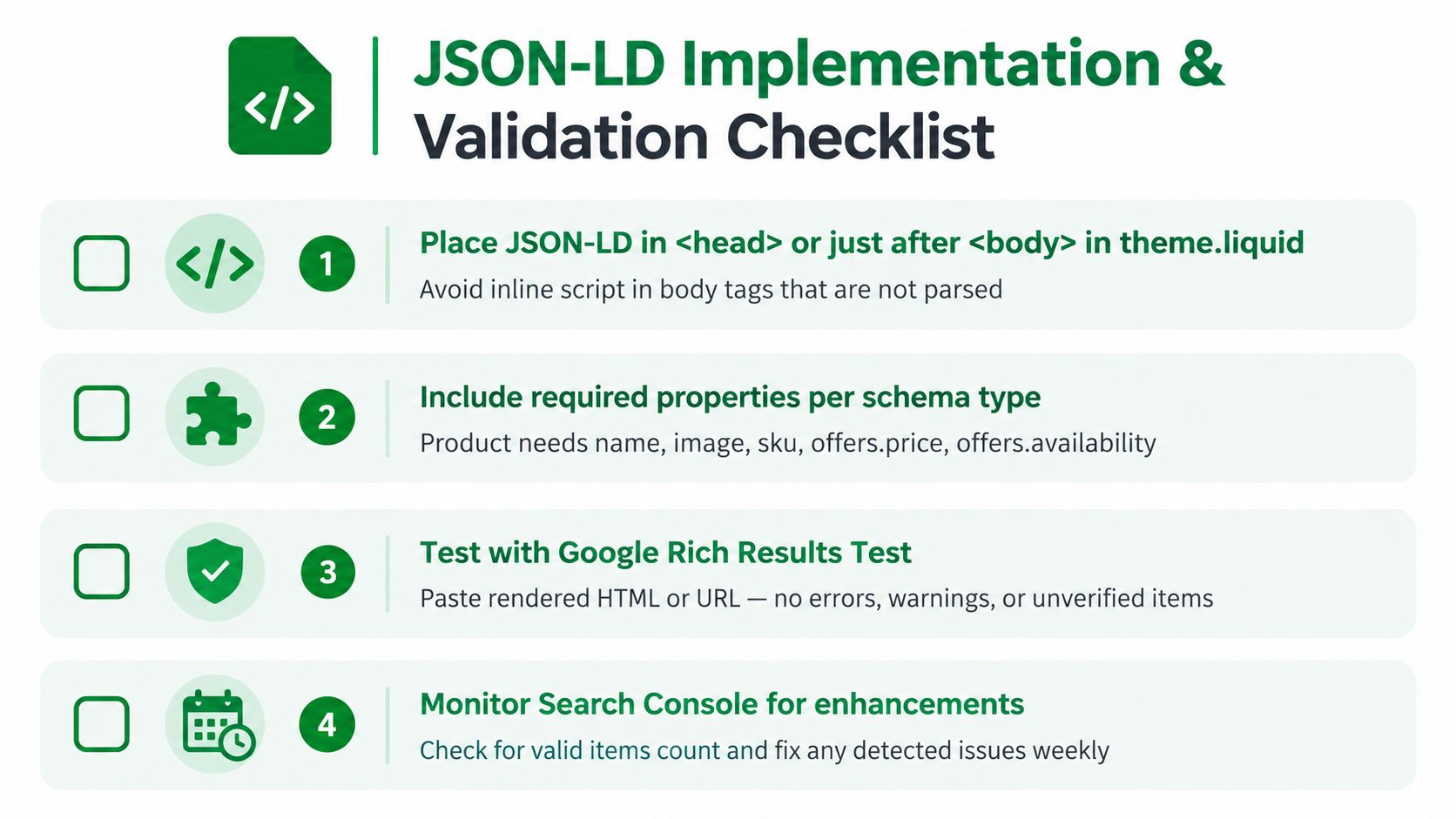
Search Console reporting is useful where the relevant enhancement report still exists, but the reporting surface has narrowed. A valid result in a testing tool also doesn't guarantee that Google will display an enhancement for every query.
Managing Structured Data at Scale With RankEngine
Manual schema editing becomes fragile as a Shopify catalog grows. Product data changes, collections are reorganized, articles are updated, apps add their own markup, and theme releases alter the rendered HTML. A one-time installation can look successful while important pages drift out of sync.
A unified workflow treats structured data as an ongoing data-quality process:
- Audit the catalog: Review products, pages, collections, blog articles, images, and existing schema.
- Assign severity: Separate missing or invalid markup from optional improvements and items requiring merchant judgment.
- Write supported fixes: Generate JSON-LD through the Shopify theme-app integration rather than scattering manual edits across templates.
- Verify the storefront: Re-read live Shopify values and confirm that the published page contains the intended output.
- Monitor and recover: Keep action history, restore points, and undo options for supported changes.
RankEngine combines Shopify SEO auditing with structured data management for Product, Article, Organization, Breadcrumb, FAQ, and LocalBusiness markup. Its workflow is designed to verify a change against the live store before marking it complete, which addresses a common problem with optimistic dashboards that report success without confirming what shoppers and crawlers receive.
The same workspace also covers adjacent answer-engine readiness, including llms.txt, agent.json, AI-crawler access controls, machine-readable product manifests, and visibility tracking across ChatGPT, Claude, Gemini, and Perplexity. Those controls don't replace content quality or search fundamentals. They reduce the chance that product information remains trapped inside a theme or scattered across inconsistent app outputs.
Operational insight: For a large catalog, the valuable asset isn't a schema snippet. It's a verified loop connecting source data, rendered markup, validation, monitoring, and rollback.
That distinction matters after a seasonal price change or theme update. Your team can investigate a specific product or page, identify whether the issue came from missing source data or broken injection, and correct the underlying workflow instead of repeatedly patching individual URLs.
Turning Markup Into Measurable Visibility
Structured data for SEO works best when you treat it as product packaging for machines. The product page supplies the contents, the visible storefront supplies the customer experience, and JSON-LD adds clear labels that help search engines and answer systems interpret both.
Start with the page types that carry commercial and brand value. Implement Product markup from live variant data, establish Organization identity on the homepage, add BreadcrumbList where the hierarchy is visible, and use Article markup for genuine editorial content. Add LocalBusiness only when a real local business entity applies, and keep FAQ content useful without assuming it still produces a Google rich result.
Then validate the published page. Check for duplicate markup, stale prices, missing availability, mismatched variants, inaccessible URLs, and properties that don't appear to shoppers. After that, monitor the results and the implementation itself, because a theme change can undo technically correct work without producing an obvious storefront error.
The most durable strategy is selective, accurate, and continuous. A small set of well-matched schemas can create clearer eligibility signals than a sprawling collection of unsupported types, while centralized verification keeps those signals aligned with the store as it changes.
Audit your Shopify products, articles, collections, and existing JSON-LD with RankEngine, then use its verified fixes and live-store monitoring to keep product facts, availability, and structured data aligned after catalog and theme changes. Visit RankEngine to turn structured data maintenance into a repeatable visibility workflow rather than a one-time code edit.