 RankEngine
A Shopify growth lead opens the weekly report and sees organic clicks slipping on a product page that still ranks well. Then the support inbox brings a stranger signal: shoppers say ChatGPT or Gemini recommended a competitor. The page hasn't disappeared from search, but it's missing from the answers customers are using to compare products.
That's the shift behind answer engine optimization (AEO). Traditional SEO helps a page earn a place in search results. AEO helps an answer engine retrieve the page, verify its claims, and cite it in a generated response. For Shopify merchants, the practical question is no longer just “Where do we rank?” It's also “Which engines use our store as evidence, and for which questions?”
Table of Contents
- Why Your Best Product Page May Be Invisible to AI Search
- What Answer Engine Optimization Actually Means
- The Evidence That AEO Is a Real Discipline
- Technical Prerequisites Shopify Stores Get Wrong First
- Why One AEO Score Hides the Real Story
- Building Your AEO Signal Stack on Shopify
- Making Product Claims Independently Verifiable
- A Realistic 30-Day Plan and Common Misconceptions
Why Your Best Product Page May Be Invisible to AI Search
A shopper asks an AI tool which insulated bottle fits a car cup holder. Your product ranks well in search, but the answer names a competitor. Ranking got your page into search results; it did not guarantee that an answer engine could find, interpret, and cite its product details.
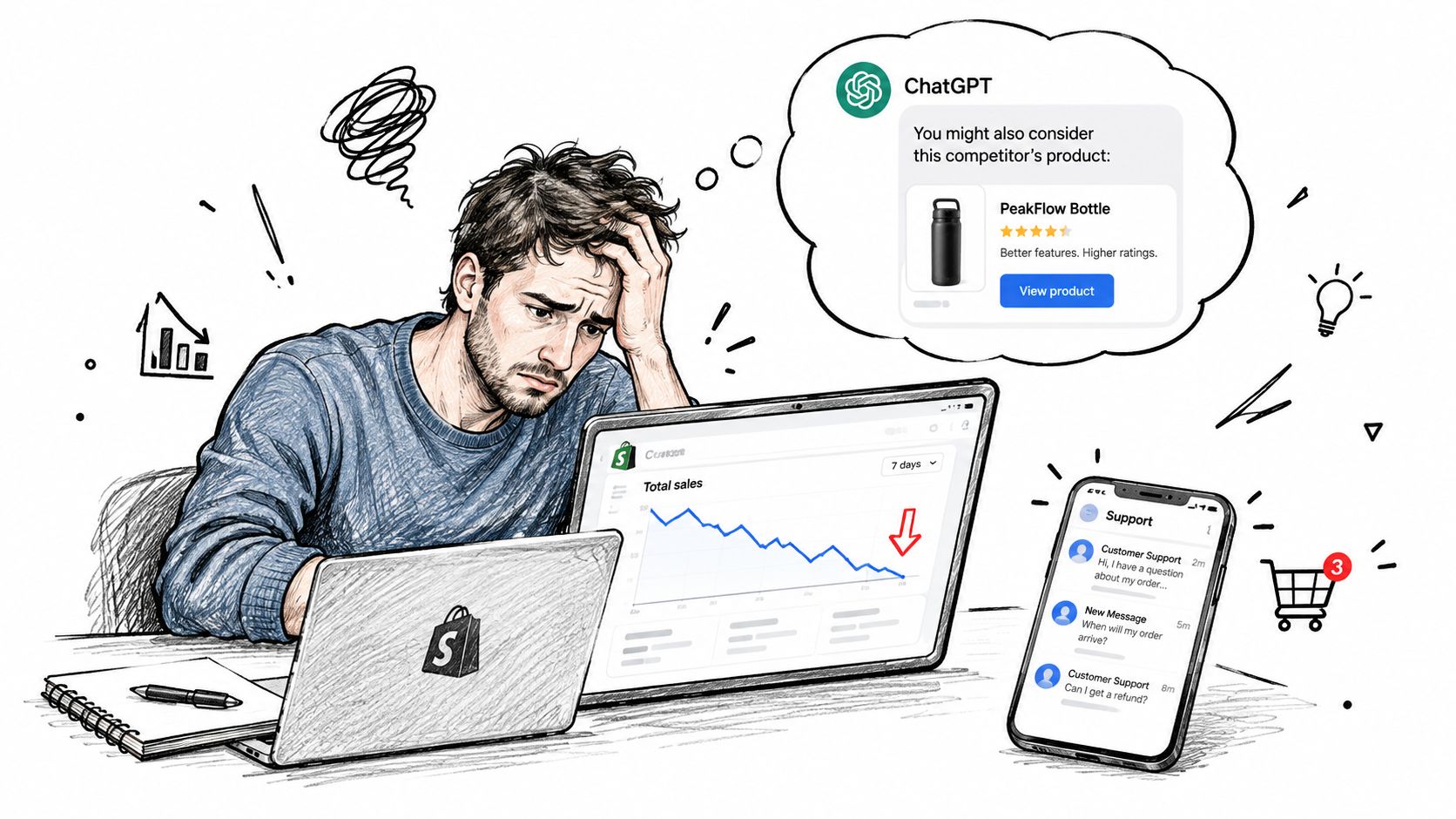
The competitor may have clearer dimensions, or the engine may rely on a marketplace listing, review, or editorial article instead. The merchant might first notice through fewer clicks or shoppers mentioning another brand. Those signals point to different problems, so check the cited sources in each engine rather than treating every missed recommendation as a ranking issue.
Traditional SEO still matters. Product titles, useful descriptions, internal links, and indexable pages help search engines discover a store's products. A practical Shopify product page SEO guide can help with those foundations. AEO work then examines whether each engine can retrieve specific product evidence and whether it cites that evidence in answers.
Pew Research Center's July 2025 analysis of Google AI summaries found that users clicked a traditional result in 8% of searches when a summary appeared, compared with 15% when no summary appeared. The analysis also found that 88% of AI summaries cited at least three sources. That makes citations worth tracking alongside rankings and clicks.
What Answer Engine Optimization Actually Means
Think of an answer engine as a new sales associate who's never stepped inside your store. The associate can only recommend what they can find, understand, and verify from available information. If your product's materials, fit, compatibility, or limitations are scattered across vague copy and inaccessible tabs, the associate has little reliable evidence to repeat.
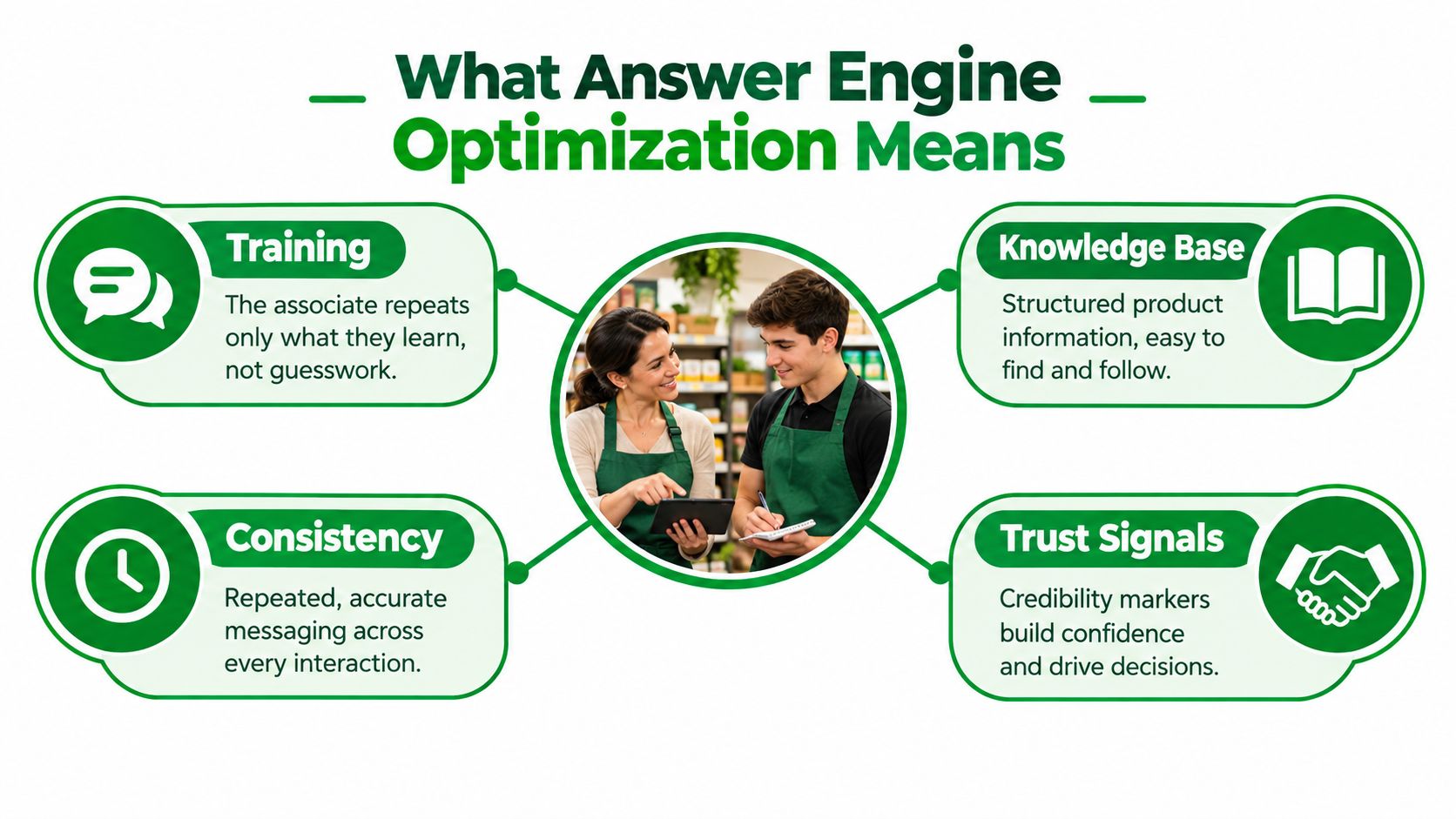
In practice, an answer engine has three jobs:
- Retrieve candidates. It needs to find pages that relate to the shopper's question. Crawl access, indexing, and clear page content affect whether your product page can enter consideration.
- Extract claims. It has to identify the relevant facts, such as product dimensions, materials, price, or shipping terms. Explicit, consistent information is easier to interpret than a claim buried in broad marketing copy.
- Compose and cite an answer. It chooses which evidence to use and how to present it. A page that can be understood but doesn't offer specific, supportable details may still lose the citation to another source.
Each job depends on the one before it. A well-written claim can't help if the page can't be retrieved, and structured data can't rescue a product whose visible details contradict its markup.
AEO inherits much of its technical foundation from SEO: crawlable pages, useful content, clean site structure, and accurate structured data. What it adds is a sharper focus on machine-readable evidence, citation-worthiness, and visibility by engine and query. Rankings still tell you something, but they don't show whether a model cites your store or relies on a third party.
For practitioners who want a wider look at how citations are analyzed, the CitationOS analysis of AI citations offers useful context. The working definition is simple: AEO makes a store's relevant information accessible, clear, and verifiable enough to be used in generated answers.
The Evidence That AEO Is a Real Discipline
A Shopify product page can rank in search and still go uncited in an AI answer. Research on generative search offers a way to study that gap. In 2024, Princeton University researchers introduced Generative Engine Optimization at the ACM SIGKDD Conference on Knowledge Discovery and Data Mining. Their GEO-bench evaluation tested about 10,000 queries across 25 domains and nine information sources, reporting visibility gains of up to 40% for techniques such as clearer presentation, authoritative citations, and quantitative details. A related Perplexity evaluation reported gains of up to 37%. (Princeton University's GEO research)
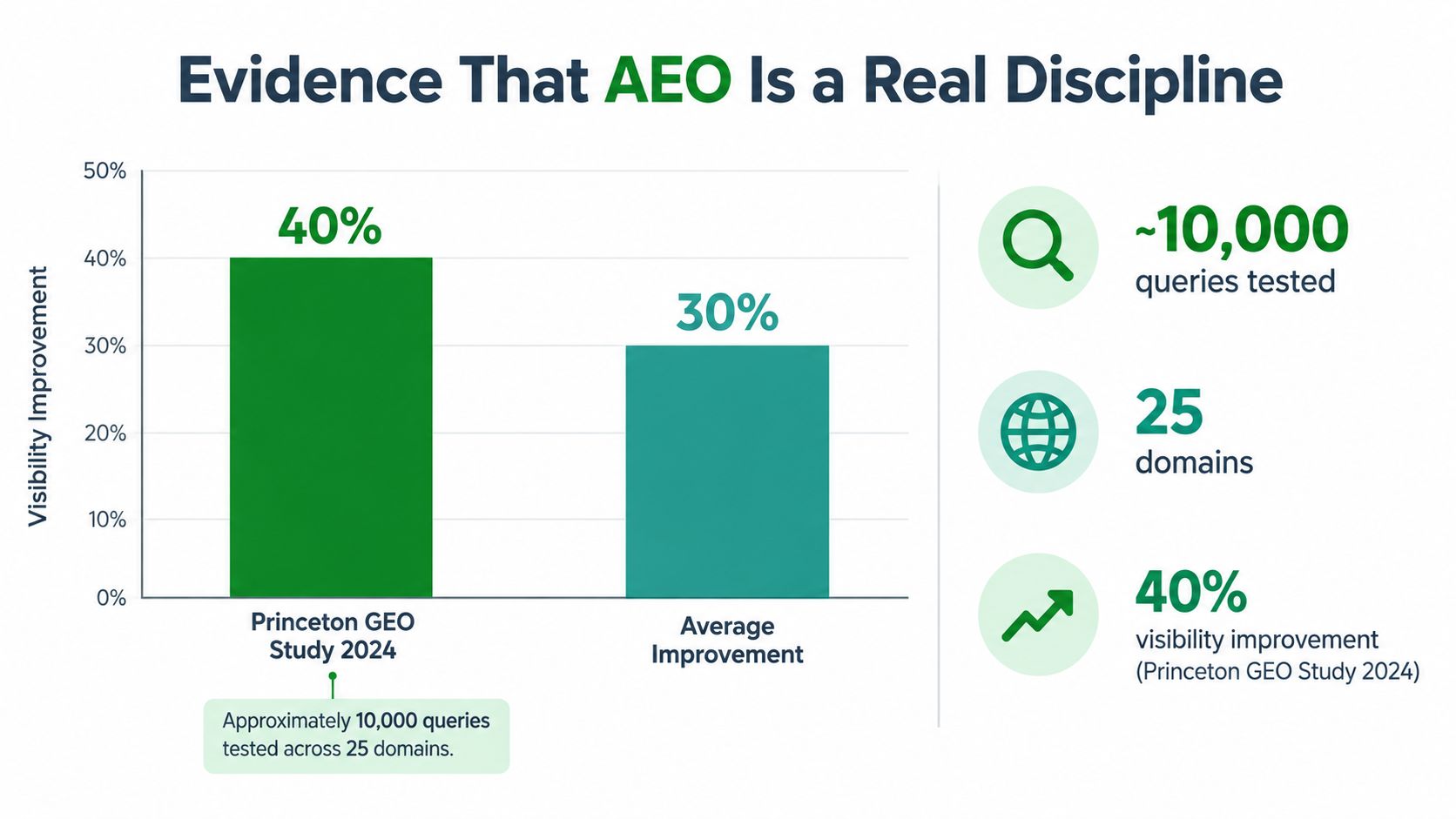
Those findings do not predict whether any particular Shopify page will earn a citation. They do show that visibility in generated answers can be measured, and that source selection can respond to how information and evidence are presented. That makes citation tracking a distinct measure from conventional rankings.
User behavior gives the issue commercial weight. Pew Research Center's analysis of 900 U.S. adults and 68,879 Google searches found that about 18% of searches produced an AI-generated summary, while roughly 58% of participants encountered at least one during the month. As noted earlier, users were more likely to end their browsing session on Google when a summary appeared.
For commerce teams, the practical takeaway is to track answer visibility, source inclusion, and citation position alongside search rankings. Clear, evidence-backed product information gives answer engines material they can assess. It cannot guarantee selection, but vague or unsupported claims give them less reason to cite the store.
Technical Prerequisites Shopify Stores Get Wrong First
Before changing AI-specific files or adding more schema, confirm that the page is accessible and usable. AEO is an indexing and retrieval problem: if a search system can't fetch a page, see its content, and understand its status, better copy won't make that page reliable evidence.
Google's guidance for its generative search features points to familiar technical prerequisites. Googlebot must not be blocked, a page should return an HTTP 200 response, and its answer-bearing content needs to be indexable. Google also says there's no special schema or required AI markup for appearing in generative features. (Google's guidance on AI features and your website)
Check what the crawler can access
Start with the page's actual response and directives. In Shopify, inspect robots rules, noindex directives, canonical targets, redirects, and sitemap discovery. A canonical pointing away from the product page or a blocked path can undermine discoverability even when the page looks correct in a browser.
Then verify the content itself. Product descriptions, specifications, and key buying details should appear in a form crawlers can read. If JavaScript controls important tabs, variants, or media information, confirm the rendered page still exposes the details clearly. Don't assume that a browser view proves every crawler sees the same thing.
Practical rule: Check the production page after a change. A successful API write doesn't prove that the live page is crawlable, correctly rendered, or serving the value you intended.
Validate the storefront, not just the settings
Check the visible product information against the JSON-LD. Product name, brand, offers, price, availability, identifiers, and eligible reviews should match the page. Shipping and return details should be clear wherever shoppers need them. A mismatch gives retrieval systems conflicting evidence and can make extracted facts less dependable.
A focused Shopify AI search optimization audit can help teams organize these checks, but the principle applies regardless of tooling: verify the live page before investing in AI-specific additions. Fix crawl access, indexability, rendering, and data consistency first.
Why One AEO Score Hides the Real Story
There's no single, reliable “AI visibility” number that captures how every answer engine selects sources. A brand can appear often in one system and rarely in another because the engines draw on different source mixes and respond differently to query formats.
BrightEdge's analysis found brands in 99.3% of ChatGPT e-commerce responses but only 6.2% of Google AI Overview responses. It also found YouTube cited in 62.4% of Google AI Overview cases. Those figures describe different surfaces and source patterns, not a universal share of voice. (BrightEdge's analysis of how AI search engines choose brands)
Xfunnel's citation analysis points to another important distinction. Product-related content represented roughly 46%–70% of cited sources, depending on query category, while product citations made up about 55% of North American citations. That doesn't mean a merchant's own product page will be cited. The engine may choose a marketplace listing, review, or comparison page that provides more independently checkable evidence. (Xfunnel analysis of product citations)
| Answer engine | Typical share of e-commerce mentions | Dominant source mix | What merchants should monitor |
|---|---|---|---|
| ChatGPT | Brands appeared in 99.3% of responses in BrightEdge's analysis | Retail and marketplace domains featured frequently | Brand mentions, product-page citations, and third-party citations |
| Google AI Overviews | Brands appeared in 6.2% of responses in BrightEdge's analysis | YouTube was cited in 62.4% of cases in that analysis | Whether the query produces an overview, which sources it cites, and whether your store is included |
| Claude, Gemini, and Perplexity | No comparable share is provided here | Source mix should be tested rather than assumed | Mentions versus citations, query intent, and cited URL |
Treat the table as a prompt for testing, not a universal benchmark. Probe product, comparison, advice, and local-intent questions separately across ChatGPT, Claude, Gemini, Perplexity, and Google's AI surfaces. Record whether the engine names the brand, cites the store's page, or relies on a third party. An unmentioned brand and an uncited brand aren't the same diagnosis.
Building Your AEO Signal Stack on Shopify
The AEO signal stack isn't a bundle of magic files. It's a coordinated way to expose useful store information, keep claims consistent, and make crawler access intentional. Start with the Shopify data and live page, then add machine-readable layers that reinforce what shoppers can already see.
A useful implementation order is:
- Product evidence first. Keep product names, variant details, specifications, offers, and policies accurate in Shopify. Metafields can hold structured attributes that need to appear consistently across product templates.
- JSON-LD next. Use appropriate Product, Offer, Organization, Breadcrumb, FAQ, or LocalBusiness markup where it accurately describes the page. Connect it to visible information, and validate the output after deployment.
- Crawler rules with intent. Review robots.txt and document which crawlers the store permits. A matrix covering Googlebot, GPTBot, ClaudeBot, PerplexityBot, and others makes access decisions explicit instead of accidental.
- Optional discovery files last. An
llms.txtfile can serve as a concise manifest for important store pages, policies, and product information. Anagent.jsonfile can provide a structured point of reference for compatible assistants or shopping agents, but neither replaces crawlable pages or accurate content.
Shopify teams can deliver these changes through theme code, a theme app extension, or supported app configuration. After deployment, check the response, rendered page, JSON-LD, and crawler access in production. Google's guidance is clear that AI-specific markup isn't a requirement, so treat these files as supporting signals rather than a substitute for technical fundamentals.
Third-party references can help establish context beyond the merchant's own claims. When editorial coverage or comparison content fits the strategy, a tool to generate listicle advertorials can help plan that work, but publication alone doesn't make a claim trustworthy. The page still needs accurate, independently verifiable details.
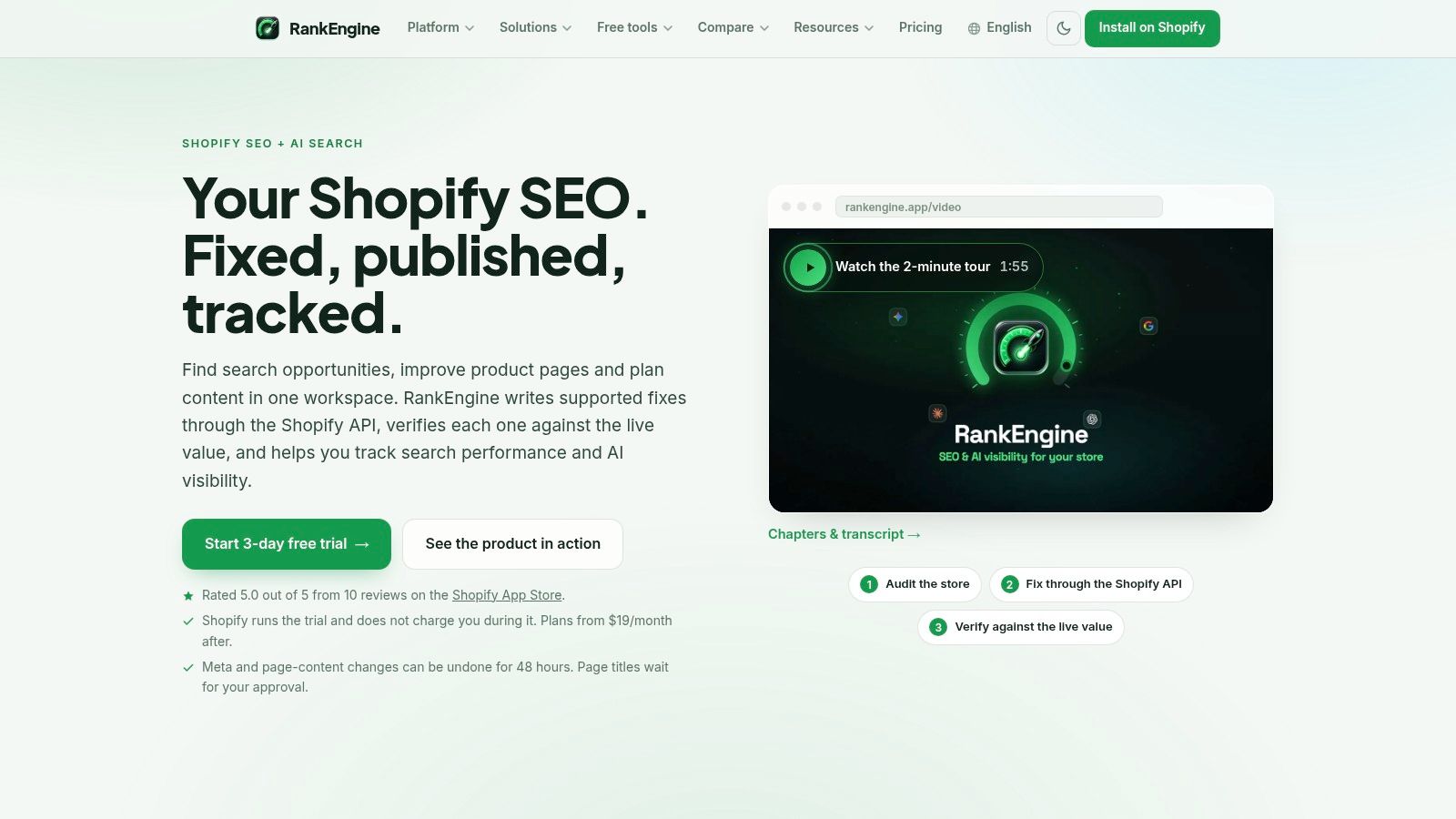
Here's a walkthrough to accompany the implementation discussion:
Making Product Claims Independently Verifiable
Structured data can tell a machine how a product page is organized. It can't make an unsupported claim credible. If a merchant says a jacket is waterproof but gives no usable definition, or a supplement page makes a benefit claim without context, an answer engine may prefer a review, comparison page, or marketplace listing that offers clearer evidence.
Build the evidence layer around details a shopper can check:
- Specifications that agree. Product copy, variant data, feeds, and JSON-LD should give consistent dimensions, materials, compatibility, and other attributes.
- Claims with context. Use measurable language where appropriate, include units, and explain limitations. A statement such as “fits most desks” is weaker than a clearly described size range and the dimensions that define it.
- Policies buyers can find. Make shipping, returns, warranties, and eligibility conditions direct and easy to locate.
- Reviews with provenance. Make clear where reviews come from and which product or variant they describe. Don't blur product feedback with general brand testimonials.
- Current commercial details. Keep price and availability aligned between the live page and structured data, particularly where variants change the offer.
Independent corroboration matters, but it has a trade-off: a retailer can't control every third-party page. Focus first on accurate first-party information, then look for trustworthy references that support the same product facts. For details on implementation, this guide to Shopify schema markup can help teams review their structured data.
Make the audit recurring rather than treating it as a one-time launch task. Check for stale prices or inventory, conflicting specifications between the page and schema, and missing context around claims. RankEngine is one Shopify option for auditing structured data and answer-engine readiness, applying supported fixes through Shopify, and verifying changes against the live store.
A Realistic 30-Day Plan and Common Misconceptions
A practical AEO rollout doesn't start with a pile of AI-specific files. It starts with the issues most likely to prevent a page from being retrieved or trusted, then moves outward to measurement and ongoing quality control.
A phased plan for a Shopify team
- Week one, audit access and rendering. Review robots rules,
noindexdirectives, canonicals, status codes, sitemap discovery, and product-page rendering. Fix blockers before rewriting copy. - Week two, align evidence. Validate Product and Offer JSON-LD against visible Shopify data. Add a concise
llms.txtonly if it helps expose important pages, then verify the production output. - Week three, test engines and claims. Run a consistent set of product, comparison, advice, and local-intent prompts across target engines. Clean up conflicting specifications and unsupported claims.
- Week four, monitor changes. Recheck key pages after theme or catalog updates. Test alerting and rollback procedures for automatic changes before expanding them.
Four misconceptions to leave behind
AEO replaces SEO. It doesn't. Crawlability, useful pages, and sound site structure remain foundational; AEO adds attention to source selection and citation.
FAQ schema alone earns ChatGPT visibility. No schema type guarantees selection across answer engines. Markup can clarify what a page contains, but the engine chooses which sources to use.
More content automatically wins. More copy can add noise if it repeats vague claims. Clear product facts, relevant context, and corroboration make content more useful as evidence.
AI-specific schema is required. Google says no special schema or required AI markup is needed for its generative features. Prioritize accessible pages and accurate information before optional files.
Set up the checks your team can sustain, then judge progress by engine, query, and citation type rather than one blended score. The best early fix is usually the one that makes an important product page easier to crawl, understand, and verify.
RankEngine audits Shopify SEO and answer-engine readiness, applies supported fixes through the Shopify Admin API, and verifies changes against the live store. If you're ready to check crawl access, structured data, and AI visibility without treating them as separate projects, visit RankEngine.